Minor Arcana · Cups
Ace of Cups
In One Line
It's already overflowing. Your only job is to stop treating the supply as an accounting problem.
What Ace of Cups Names
The Ace of Cups names feeling at its source — the opening of the heart's supply before any person, project, or reason has been assigned to it. The new love, the returning tenderness, the unprompted softening toward your own life. Like every Ace, it is an offer rather than an outcome: the water is turned on. What gets watered is the rest of the suit.
What the card understands about this kind of abundance is that it cannot be stored. The cup on this card does not hold its contents — it overflows by design, and the overflow is the point. Feeling kept for safekeeping goes stale in the keeping; the supply stays fresh only in circulation. Every attempt to ration an open heart closes it by exactly the amount rationed.
And it names where the supply comes from, which is the card's quiet radicalism: not from another person. The dove descends from above the frame. What fills the cup was never carried in by anyone who could therefore carry it away.
On This Card
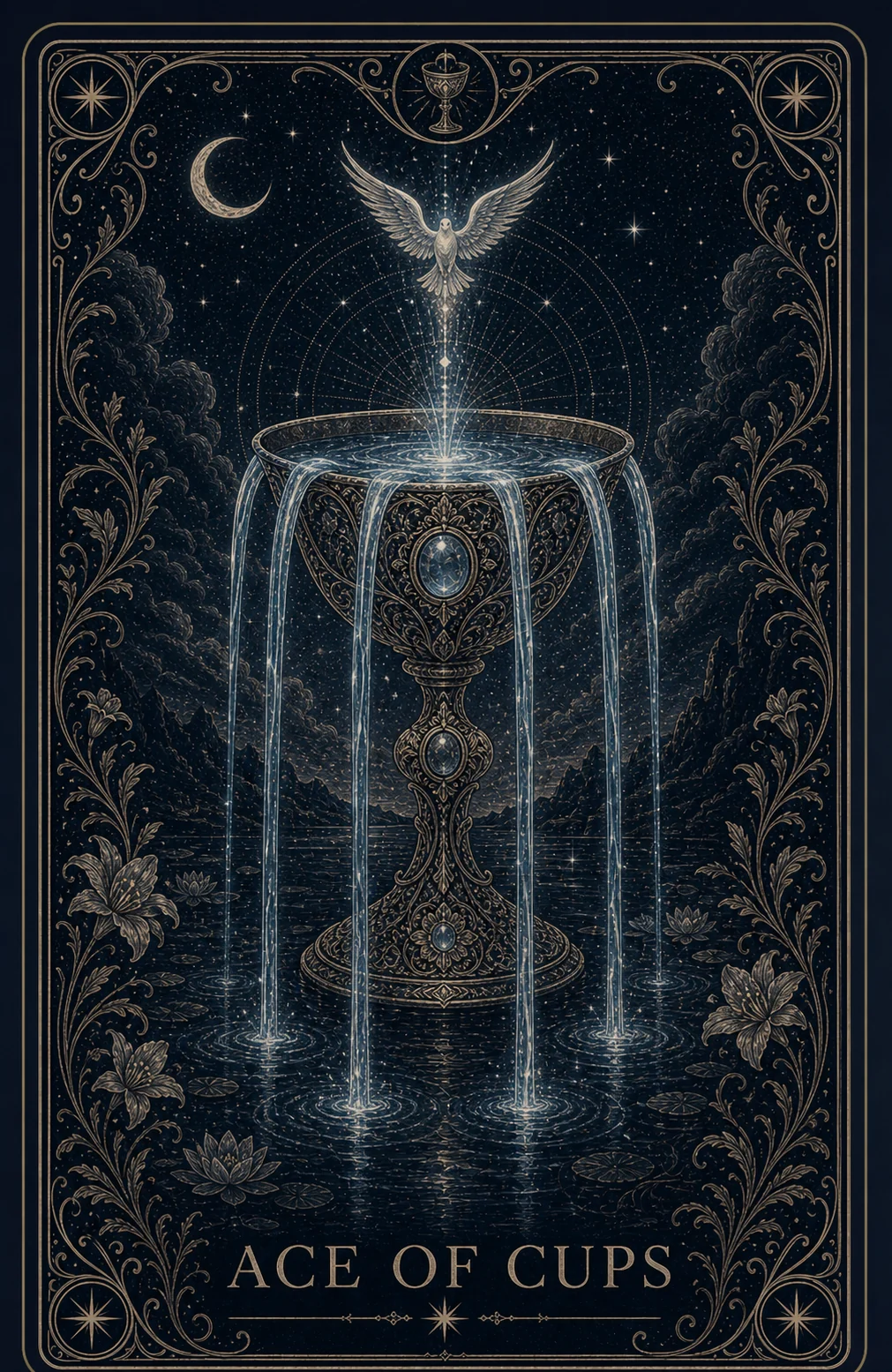
The Night Glass chalice stands in still, open water — not on land at the water's edge, but in it. The cup of feeling is planted in its own element from the first card. Around its base, lotus and lily float where the falling streams ring the surface; every overflow lands somewhere alive.
The streams themselves are the composition: they pour from the brim on all sides, evenly, unstoppably, each one silver against the dark. Nothing is spilling. This is not an accident being depicted — it is a fountain doing precisely what fountains are for.
Above, the white dove descends on a column of light that runs straight down into the cup — the supply line, drawn visibly, from above the card's own sky. The deck makes the claim in plain sight: the source of the overflow is vertical, not horizontal. It does not arrive from anyone else on the card. There is no one else on the card.
The Inverted Pattern
Running blocked, the Ace becomes the sealed spring: feeling detected and immediately managed — the softness noticed, then scheduled for later; the love available, then filtered through the question of whether it's deserved. The cup gets treated as finite and the rationing begins. The inverted question: who taught you that the supply was scarce — and what have you been keeping the cup covered for?
When It Finds You
The Ace of Cups tends to appear at the front edge of a thaw — after a guarded season, when something small undoes you at a strange moment and the feeling arrives before the explanation. It appears at the beginning of love, of a friendship with depth in it, of a creative vein that runs warmer than the usual work. And it appears as a correction to scarcity math: the heart is not a budget. Spend from it and check the level — it rises.
The Lineage
The suit's emblem was the chalice from the first Italian decks — the communion vessel, the wedding cup, the grail of the same century's romances. Painters gave the Ace its overflow early and never took it back: six hundred years of the same image, a cup filled from above and pouring past its own rim, because no era has found a better picture of how feeling actually works.
The Signal Door
What it names in you is different.
This is what Ace of Cups means in general. What it names in you is a different question.
The Signal reads one card for you — your name, where you actually are, and a pattern named with precision. It opens once per person.