Minor Arcana · Cups
Knight of Cups
In One Line
The offer is beautiful and it is moving at walking pace. You have time to check what's actually in the cup.
What Knight of Cups Names
The Knight of Cups names feeling in motion — the heart's energy committed to a direction and riding toward it. He is the suit's courier of offers: the declaration, the proposal, the invitation with candlelight in it. When he appears, something romantic in the broad sense — a person, a project, a vision of how life could feel — is approaching, carried formally, held out ahead of the rider.
The card honors what this figure does that bolder knights can't: he moves at the speed of meaning. Where the Knight of Wands charges, this one processes — the pace of a vow, not a raid. Feeling that arrives at walking pace can be met, questioned, and answered. The card asks its receiver to do exactly that.
Because its one caution is built into the image: the cup is carried ahead of the face. Offers of feeling lead with the vessel. What the Knight is like on foot, at home, out of the beautiful armor — the cup doesn't say. Loving the offer and knowing the rider are two different stages, and the walking pace exists so you can do both.
On This Card
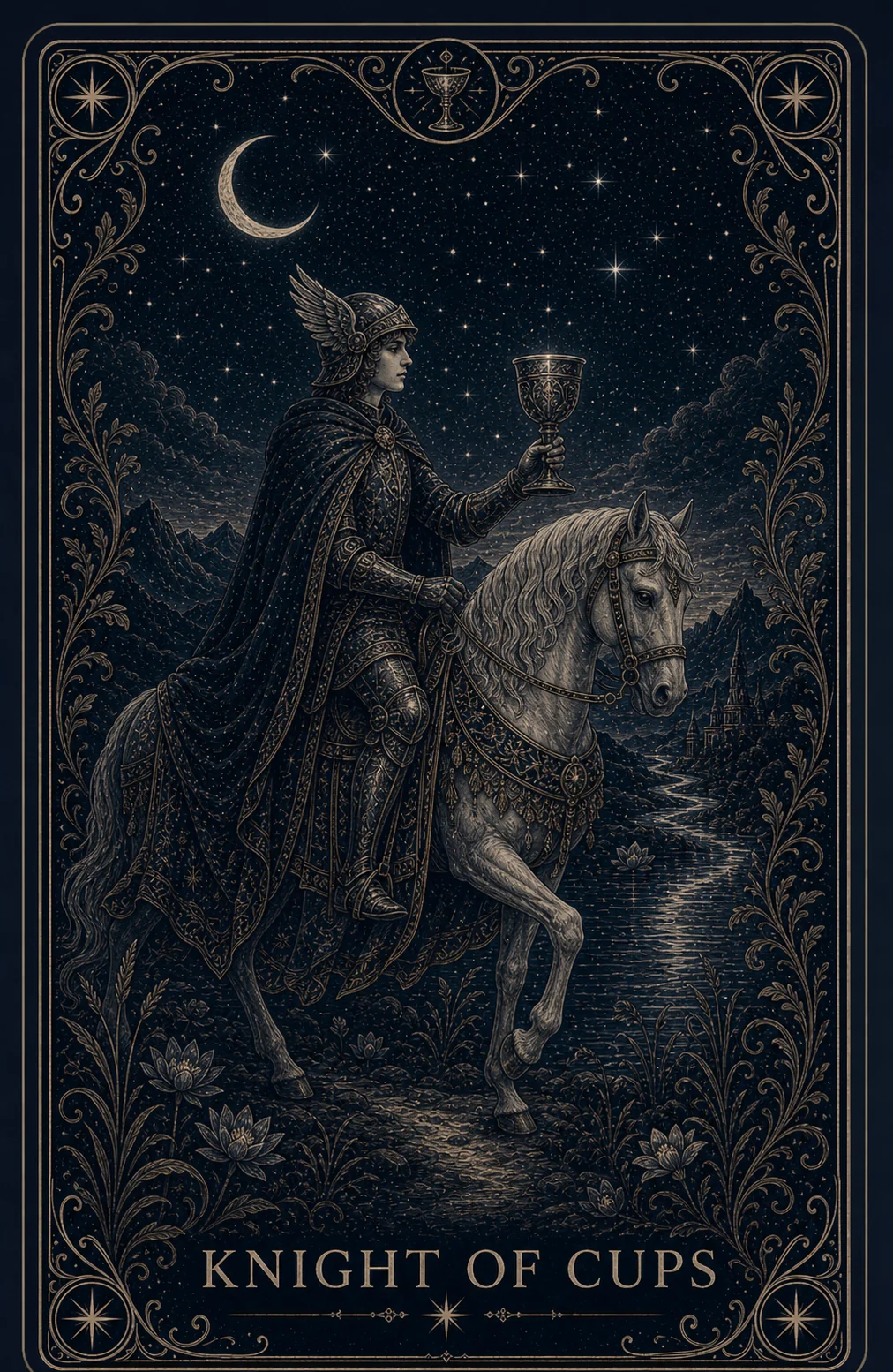
The Night Glass horse is mid- step — one foreleg lifted, head lowered, calm — the only mount in the deck moving at a ceremonial walk. The deck sets the suit's tempo in the gait: feeling travels at processional speed or it isn't feeling, it's appetite in a costume.
The Knight wears the winged helmet — thought given lift, the old sign of the messenger — and his cup is held forward at full arm, level, steady at a walking pace that would spill it at any faster one. The composition is a physics lesson: this offer's credibility is its speed. What's carried level and slow is being carried carefully.
And he follows the river. The moonlit water winds ahead of him toward a distant castle, and his path runs beside it the whole way — a knight navigating by watercourse, led through the dark by the very element he serves. Lotus blooms mark the banks where he passes.
The Inverted Pattern
Running blocked, the Knight becomes the offer that is only an offer: in love with approaching, gorgeous at the declaration, absent at the follow-through — the cup presented and re-presented to a series of recipients because the presenting is the part that feeds him. Or the receiver's block: every walking-pace offer spurred into a gallop or refused at the gate. The inverted question: do you love this — or do you love being the one arriving with the cup?
When It Finds You
The Knight of Cups tends to appear when an offer is approaching — love, invitation, the project that courts you back. It appears when you are the rider: something in you ready to be declared, needing the formal carry and the level cup. And it appears as a tempo correction in either direction: feeling is processional. Slow the charge, or stop stalling the walk.
The Lineage
The cavalier of the chalices rode out of the first Italian courts as the suit's emissary — the knight-errant of the same century's romances, cup borne ahead like a pledge. The painters kept his horse at a walk through six centuries of decks. They knew the difference between a courtship and a raid, and they fixed it in the gait.
The Signal Door
What it names in you is different.
This is what Knight of Cups means in general. What it names in you is a different question.
The Signal reads one card for you — your name, where you actually are, and a pattern named with precision. It opens once per person.