Minor Arcana · Cups
Ten of Cups
In One Line
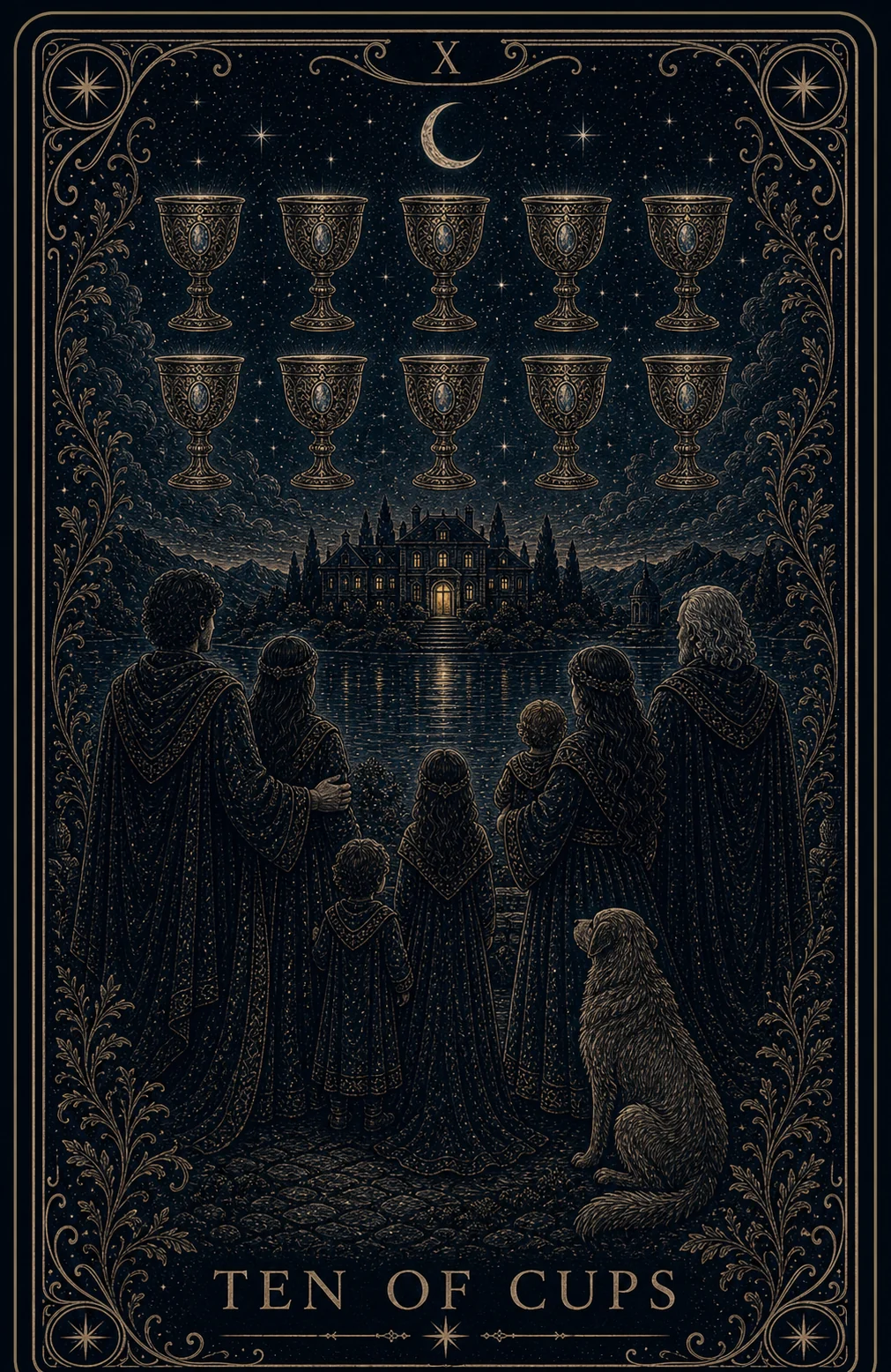
Notice what the whole family is looking at: not the ten cups. The lit house. Belonging looks at the home, not the score.
What Ten of Cups Names
The Ten of Cups names belonging — the suit's completion, where feeling stops being an event between individuals and becomes a place people live. Not the wedding-toast peak; the long structure after it. The family in whatever form yours took, the people whose presence is the definition of arriving home.
What the card insists on is that this is built weather, not found weather. Tens complete their suits, and completions are constructions: the Ten of Cups stands on every card beneath it — the source opened, the level exchange, the witnessed joys, the grief crossed at the bridge, the departures taken toward the missing ninth. Households of this kind are not luck. They are the compound interest of feeling handled honestly for years.
And it names the completion's quietest feature: nobody in it is counting. The cups hang in the sky like weather because that is what fulfilled feeling becomes — the climate of a household, present everywhere, pointed at by no one.
On This Card
The Night Glass family stands with every back to the viewer — parents, children, an elder, a small one held on a hip — and every face toward the same thing: the house across the water, windows lit, one warm doorway reflected all the way over the lake toward their feet. The deck's composition makes the definition: belonging is a group of people facing the same warmth.
The ten cups hold their double arc high in the star field, and no one looks up at them. The score hangs in the sky, achieved and ignored — the card's driest, kindest joke. People inside real fulfillment don't check the count.
And seated among them, the dog — face lifted, watching the house with the family. The deck seats the loyal witness inside the circle, not at its edge. Every true household has at least one member whose entire contribution is presence, and the card counts them.
The Inverted Pattern
Running blocked, the Ten becomes the postcard: the household arranged to photograph as belonging while the feeling went somewhere unexamined — harmony maintained by everyone agreeing not to say the true thing; or the completion deferred forever, home treated as a milestone the current people never quite qualify for. The inverted question: does your household share a warmth, or an agreement to perform one — and which conversation is being paid to keep the difference invisible?
When It Finds You
The Ten of Cups tends to appear when the thing you built is quietly working — the ordinary evening that is, in fact, the arrival — and deserves to be felt before it's normalized. It appears when family is being chosen, blended, or repaired, as the blueprint: same direction, shared warmth, witnesses included. And it appears to those still walking the Eight's mountain path, as the honest postcard from where it leads.
The Lineage
The family beneath the arc of cups closed this suit in the old decks the way harvest closed the year — the household, the roof, the vessels raised over both like a blessing said nightly. The Renaissance built its whole world around exactly this image: the casa, the generations, the lit door. The card has been the point of the other thirteen for six centuries.
The Signal Door
What it names in you is different.
This is what Ten of Cups means in general. What it names in you is a different question.
The Signal reads one card for you — your name, where you actually are, and a pattern named with precision. It opens once per person.