Major Arcana
IX — The Hermit
In One Line
You don't need the whole road lit. You need the next step — and you already have that much light.
What The Hermit Names
The Hermit names the season of the smaller light. Not loneliness — solitude with a function: the deliberate stepping back from other people's voices because your own has become inaudible in the crowd of them. He arrives when the next answer cannot be borrowed, googled, or voted on. It has to be walked to, alone, at the pace of one honest step at a time.
His central mercy is the size of what he asks. People stall at thresholds demanding to see the whole route — the five-year plan, the guaranteed outcome, the fully lit road. The Hermit's lantern makes the deck's quietest argument: sufficiency. Enough light for the next step is enough light. The demand for more is usually not prudence but postponement wearing prudence's coat.
And he names the difference between withdrawing from life and withdrawing into it. The Hermit is not hiding. He is on the mountain, in motion, doing the one kind of finding that requires no witnesses. The people who return from Hermit seasons come back with something — that is how you can tell it was a pilgrimage and not an exile.
On This Card
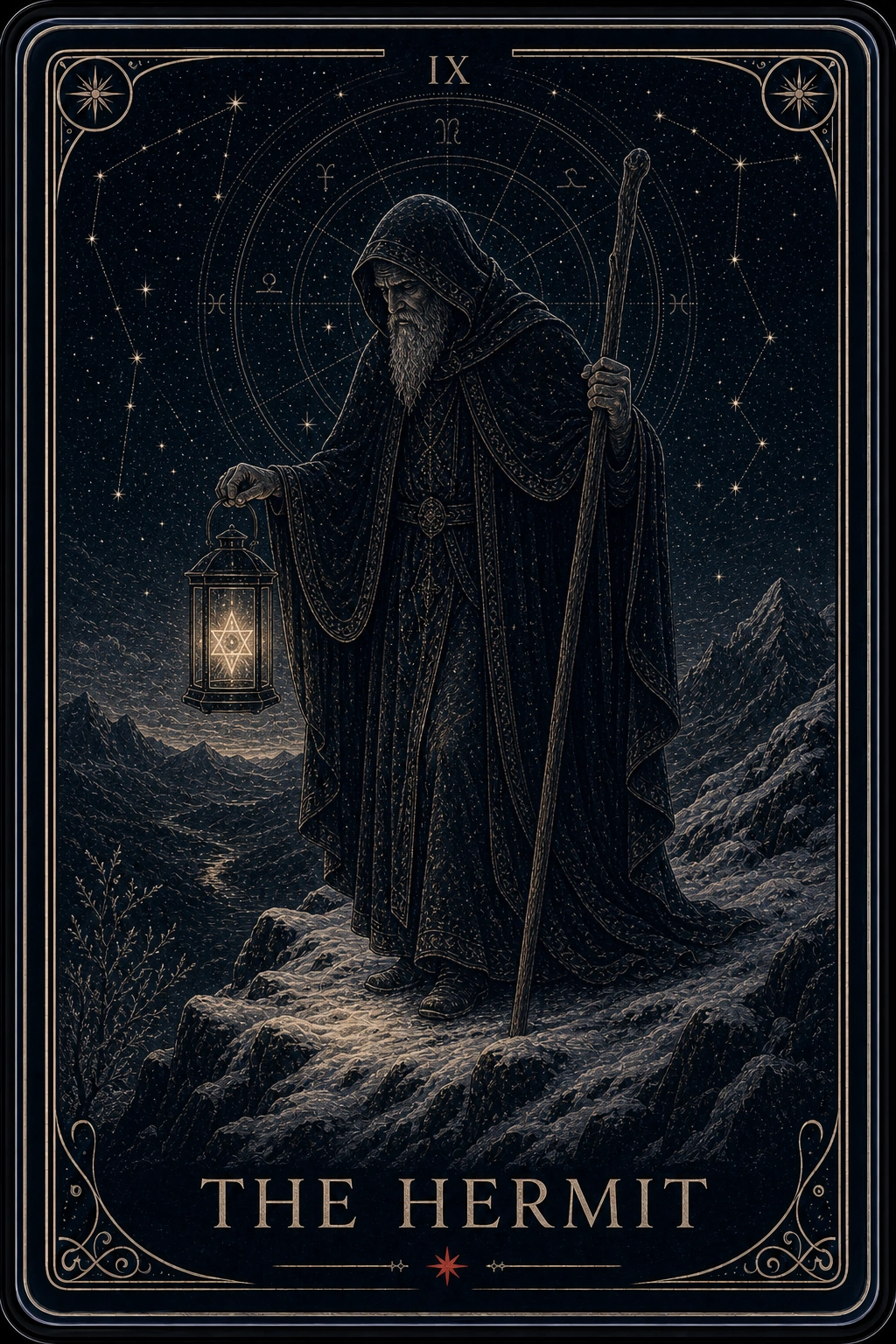
The Night Glass Hermit holds his lantern low — not aloft, scanning the horizon, but down near the ground, lighting the next few feet of the ridge. The deck put the card's entire philosophy into that angle of the arm. The horizon is not his business tonight. The footing is.
Inside the lantern burns a six-pointed star — a piece of the sky, carried. The same light filling the constellations above him is what he holds in his hand: the guidance was never only up there. Some of it travels with him.
Behind his head, faint in the night, a great ring of zodiac signs turns — the deck's map of every season and cycle, worn like a halo at a distance. He walks inside the larger pattern without needing to read it all tonight. And far below, the valley he came from glimmers — still visible, not renounced. This solitude has a return ticket. The staff is planted, the snow holds his prints, and the path continues exactly one lantern's reach at a time.
The Inverted Pattern
Running blocked, The Hermit becomes the exile that calls itself a pilgrimage: isolation past its harvest, the mountain as a hiding place, wisdom gathered and gathered and never brought down to anyone. Or the refusal of the season entirely — filling every silence with podcasts and opinions so the inner voice never gets the floor. The inverted question: is your solitude producing anything — or protecting you from something? And if you've refused solitude completely: what are you making sure you never hear?
When It Finds You
The Hermit tends to appear when you've asked everyone's opinion except your own — the decision crowdsourced into paralysis. He appears at the start of seasons that require unfashionable quiet: the deep study, the long grief, the slow rebuild. And he appears when the demand for the whole lit road has kept you standing still for months, holding his lantern at exactly one step's worth of light, asking whether you'll take it.
The Lineage
In the earliest Renaissance decks he carried an hourglass — Time himself, walking. The centuries traded it for a lantern and improved the truth: what the solitary walker carries is not time running out but light running exactly far enough. Six hundred years of seekers have followed that small flame up the same mountain.
The Signal Door
What it names in you is different.
This is what The Hermit means in general. What it names in you is a different question.
The Signal reads one card for you — your name, where you actually are, and a pattern named with precision. It opens once per person.