Major Arcana
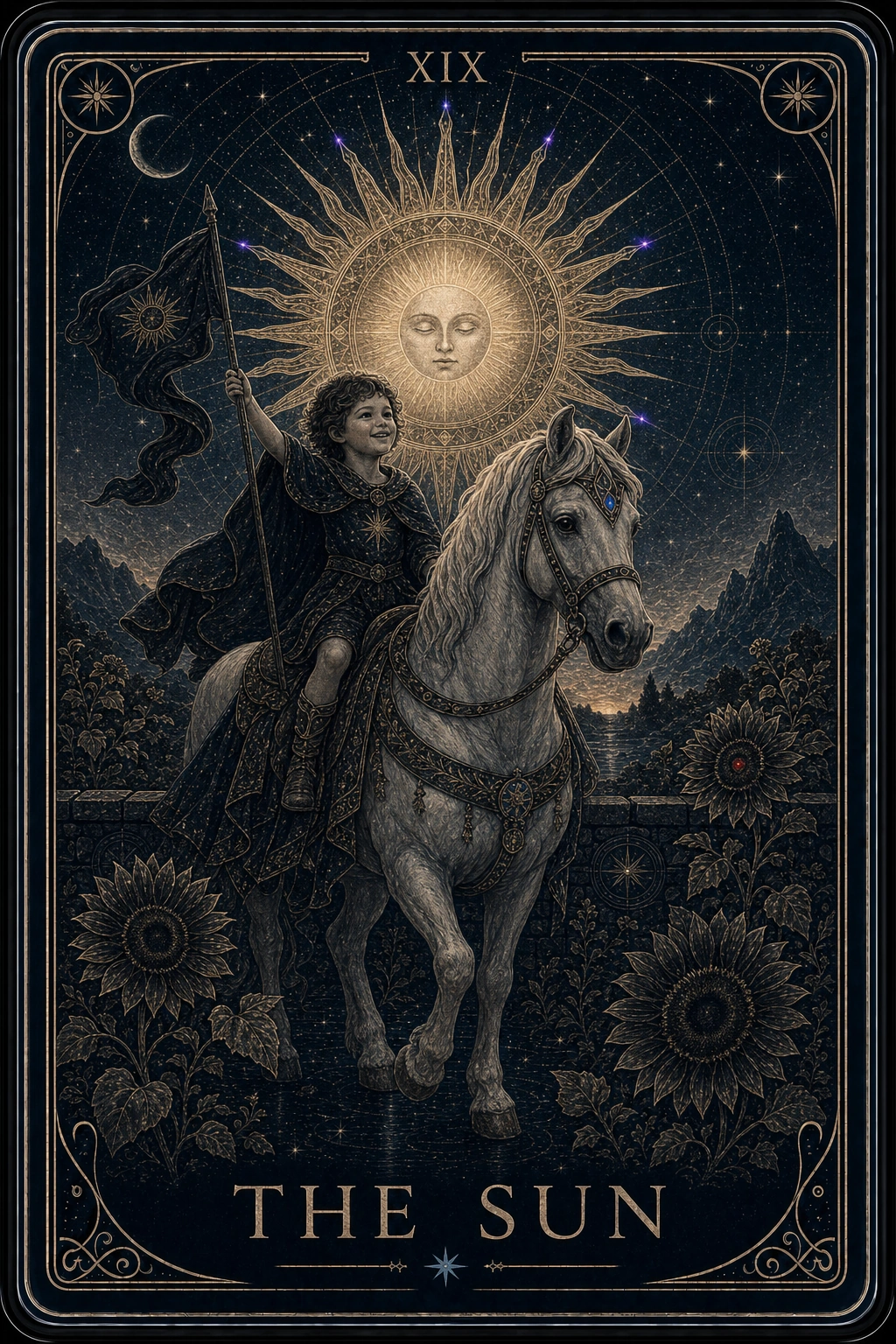
XIX — The Sun
In One Line
You've been earning warmth that was never supposed to be priced. Some things get to be uncomplicated.
What The Sun Names
The Sun names the moment nothing has to be performed. Not happiness as achievement — happiness as climate: the room where you are legible, the work that fits, the love that doesn't require a case to be argued. Its arrival in a reading is usually less a prediction than a diagnosis: some warmth is already present, and the question is whether you can stand in it without auditioning.
Because that is the card's real teaching, and it is harder than it sounds. People who learned early that warmth was conditional become expert earners of it — impressive, accommodating, tireless — and then cannot metabolize the unconditional kind when it finally arrives. They suspect it, discount it, or work harder to deserve what was already freely given. The Sun stops that machinery. It says: visible, as you are, in full light — and nothing bad happened.
It is the deck's simplest card, and its simplicity is the medicine. Not everything true is complicated. Some things are exactly what they look like. The child knows this. The card exists to remind everyone who used to be one.
On This Card
The Night Glass Sun blazes in a night sky — the deck's boldest choice. Every other deck gives this card a daytime. Night Glass keeps the darkness and puts the sun in it anyway, because that is where joy actually lives: not after the dark is over, but inside it, outranking it. A thin crescent moon still hangs in the corner. The night didn't end. It was outshone.
The sun itself has a face at rest — eyes closed, serene, radiating without effort. It is not watching, judging, or approving. It shines because shining is its nature, the card's whole argument about real warmth rendered in one expression.
Below, a child rides a pale horse bareback, banner lifted, laughing — no armor, no saddle, no grip of white-knuckled control, the only unguarded face in the entire deck. And the sunflowers turned toward them are dark with glowing red hearts: even the flowers of this deck keep their night colors. Joy here doesn't bleach the world. It lights it as it is.
The Inverted Pattern
Running blocked, The Sun becomes performed shine: the relentless positivity that is actually armor, the achievement treadmill where every warmth must be re-earned by Friday, the smile doing security work. Or joy deferred on principle — the belief that unguarded happiness tempts fate, so every good day gets a tax paid in advance worry. The inverted question: when something warm arrives with no invoice attached, what do you immediately start doing — and who taught you to do it?
When It Finds You
The Sun tends to appear when something good is already here and being inspected instead of enjoyed — the relationship waiting for its other shoe, the win discounted before the applause ends. It appears around children and beginnings, where unperformed joy is still native. And it appears as the deck's plainest instruction: this one is not a puzzle. Stand in it.
The Lineage
A sun with a human face over a child on horseback — the image has meant the same thing since the Renaissance painted it, and it has resisted six centuries of attempts to complicate it. The oldest decks and the newest agree on almost nothing except this card. Warmth, visibility, the unarmored self. It has never needed retranslation.
The Signal Door
What it names in you is different.
This is what The Sun means in general. What it names in you is a different question.
The Signal reads one card for you — your name, where you actually are, and a pattern named with precision. It opens once per person.