Minor Arcana · Pentacles
Eight of Pentacles
In One Line
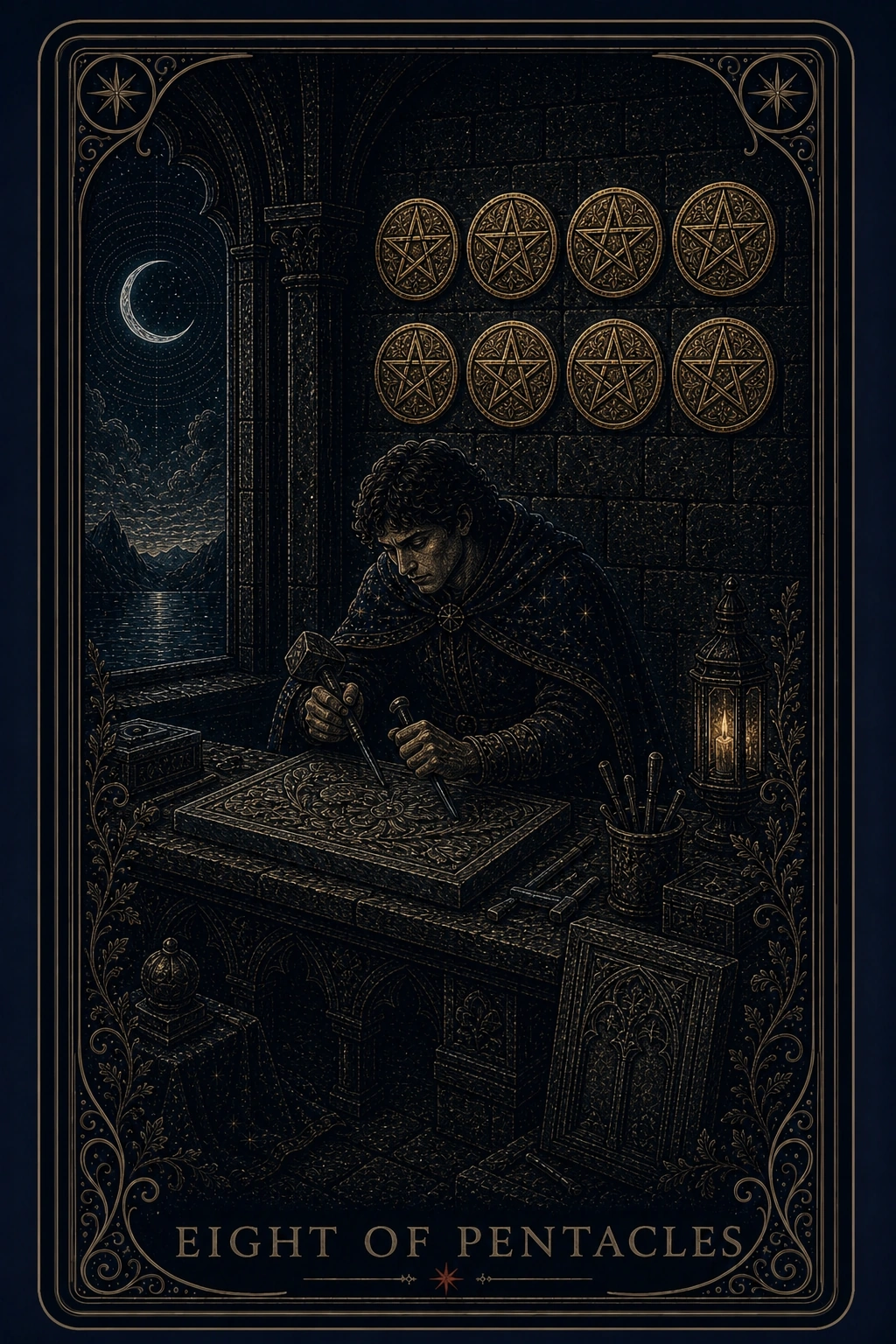
Eight on the wall and he's not looking at any of them. The whole card is the ninth — the one under his hands.
What Eight of Pentacles Names
The Eight of Pentacles names mastery in the making — the long middle of skill, where excellence stops being an event and becomes a habit of hands. The card's subject is repetition with attention: the same cut made a thousand times, each one watched like the first, the craft advancing by increments invisible on any single day and unmistakable across the wall.
What it teaches is the relationship between the finished and the current. Eight completed works hang mounted — a real record, honestly earned — and the craftsman's entire attention is on the unfinished ninth. That is the posture of everyone who ever got truly good: the portfolio faces the visitors, the eyes face the bench. The moment the gaze reverses — the work watched less than the wall — the ninth piece starts declining, and the wall soon follows.
And it dignifies the unglamorous hour. This is the suit's night- shift card: no audience, no ceremony, one lantern, one graver, and the compound interest of showing up to the bench again. Mastery has no other address.
On This Card
The Night Glass craftsman works at night — the deck's choice, and a loaded one. Through the Gothic window, the crescent hangs over dark water; inside, one lantern burns at his right hand, throwing its light on exactly one thing: the panel under the chisel. The world is asleep. The work is not. The card locates mastery's real hours with total honesty — the ones nobody sees and everything depends on.
The eight finished coins hang on the stone wall in two even rows — mounted like a guild's proof-pieces, each one carrying the same floral pattern he is mid-carve on the ninth. The deck lets you check his consistency yourself: wall and bench, same standard. That match, verifiable at a glance, is what a reputation physically is.
His head is down, both hands engaged — mallet and graver, mid-stroke, the posture identical to the mason of the Three but alone now, deeper in, past the watchers. The suit's craftsman grew up between those two cards, and the deck drew the growth as subtraction: fewer people, same stone, better hands.
The Inverted Pattern
Running blocked, the Eight becomes motion without deepening: repetition with the attention removed — the ten-thousandth cut made like the hundredth, craft plateaued into routine — or the wall takes over, polishing and arranging the finished eight while the ninth sits unstarted. Busy is this card's cheapest counterfeit. The inverted question: is your current practice making you better — measurably, at what, since when — or just making you tired on schedule?
When It Finds You
The Eight of Pentacles tends to appear at the start of a real apprenticeship — the skill that will take years and pay for decades. It appears mid-plateau, when the increments have gone invisible and quitting is whispering. And it appears as permission for the night shift: the unwitnessed hours are not lost hours. They are where the wall comes from.
The Lineage
The apprentice at his bench, works mounted above him, is the guild system painted onto card stock — the bottega, the workshop economy that built the Renaissance one proof-piece at a time. Masterpiece was a technical term: the piece that proved the hands. Six centuries later the card still runs the old shop rule — the wall shows what you were. The bench shows what you are.
The Signal Door
What it names in you is different.
This is what Eight of Pentacles means in general. What it names in you is a different question.
The Signal reads one card for you — your name, where you actually are, and a pattern named with precision. It opens once per person.