Minor Arcana · Pentacles
Three of Pentacles
In One Line
The mason has the chisel. The watchers have the plans. The cathedral needs all three people — that's the whole card.
What Three of Pentacles Names
The Three of Pentacles names craft meeting collaboration — the first card in the suit where the work gets witnessed, funded, and joined. The skilled hands, the one who holds the vision, the one who holds the resources: three roles, one build. It marks the moment a private competence becomes part of something too large for one set of hands, which is both a promotion and a surrender.
What the card blesses is the meeting itself. Craft alone makes objects; craft in counsel makes cathedrals. The mason on this card is better because he is watched — not surveilled, consulted. His work is being taken seriously enough to discuss, which is the form respect takes in the material world. The card asks its holder to stop reading feedback as interference and start reading it as scaffolding.
And it holds the quiet tension every collaboration carries: three people can share a build and not a rank. The Three works when each role is honored as load-bearing — and begins failing the day any one of the three decides the other two are decoration.
On This Card
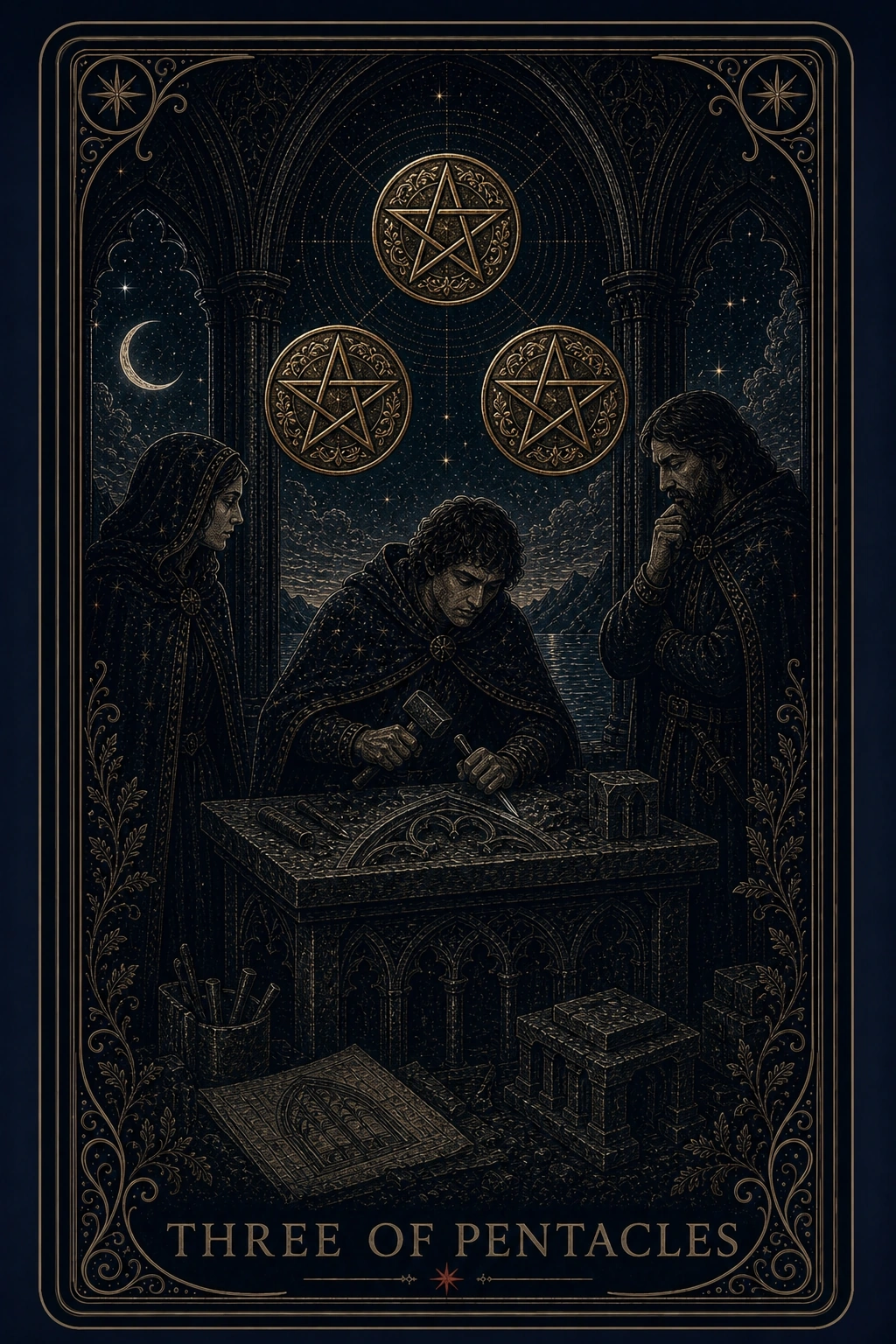
The Night Glass mason works while the others confer — head down, mallet and chisel mid-stroke, fully inside the cut. The deck caught the exact division of labor: his attention is on the stone, theirs is on him and each other. One watcher ponders, hand at chin; one attends quietly. Nobody idles. Three different kinds of work are happening in one frame, and only one of them makes chips.
The plans lie spread at the base of the bench — drawn architecture, consulted and set down, with stone blocks waiting beside them. The vision exists on paper and the paper is on the floor: in this deck's shop, the drawing serves the carving, never the reverse.
Above them, the three coins arc across the Gothic vaulting — set into the architecture itself, the way this suit's rewards actually arrive: not handed to any of the three, but built into the thing they're raising, where all of them can stand under it.
The Inverted Pattern
Running blocked, the Three becomes the shop with one believer: craft performed for approvers who never arrive, or collaboration where one role quietly annexes the others — the visionary who re-carves the mason's cuts, the funder who reads the plans as invoices. The build continues; the building stops. The inverted question: in your current shared work, which of the three roles are you actually holding — and which one are you resenting instead of recruiting?
When It Finds You
The Three of Pentacles tends to appear when your private skill is being invited into a larger build — the partnership, the commission, the team. It appears when working alone has hit its ceiling and the next level is structurally collaborative. And it appears as a staffing audit: every stalled project is missing one of the three — hands, vision, or means. Name which, and the stall explains itself.
The Lineage
The mason in the cathedral is among the suit's oldest scenes — the apprentice at the arch, the monks with the plans, painted by the very centuries that raised Europe's stone. Those buildings took longer than the lives of anyone who started them: the card is the Renaissance's own theology of collaboration. Nobody builds a cathedral. Three roles, sustained, build a cathedral.
The Signal Door
What it names in you is different.
This is what Three of Pentacles means in general. What it names in you is a different question.
The Signal reads one card for you — your name, where you actually are, and a pattern named with precision. It opens once per person.