Major Arcana
XX — Judgement
In One Line
That pull you keep feeling isn't guilt. It's something you buried, hearing its name.
What Judgement Names
Judgement names the call — the summons that comes up through a settled life and asks for what was buried. Not the courtroom its name suggests: nothing on this card is being condemned. The trumpet is not a verdict. It is a reveille, and what wakes is yours.
Everyone buries. It is how a life gets built at all — the art set down for the practical career, the voice quieted to keep a family peaceful, the self shelved because the timing was wrong. Some burials are wisdom. But the card knows what every buried thing knows: alive is alive. It waits. And at some point — often mid-life, often after a Tower or a Death has cleared the ground — it hears its name and starts answering, and the person feels it as a pull with no polite explanation. Restlessness. The ache at other people's music. The dream that keeps returning with a shovel.
Judgement's insistence is that the call requires an answer, and the answer is a rising, not a regression. What comes up does not come back as it was buried — younger, raw, badly timed. It rises into the person you are now, who can finally hold it. That is the resurrection the card has always painted: not the past restored. The buried thing, and the present self, meeting at last above ground.
On This Card
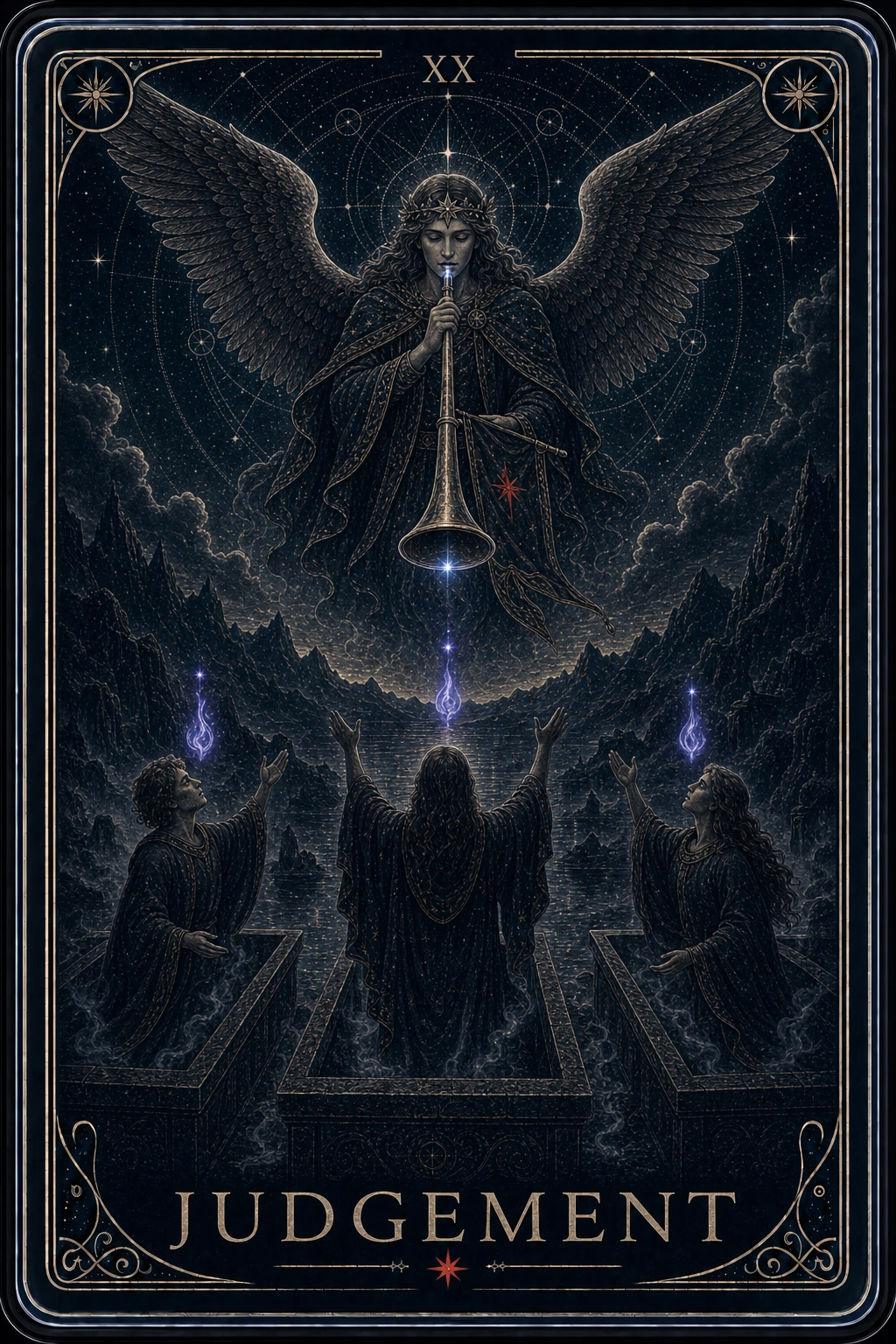
The Night Glass herald sounds the trumpet downward — into the graves, not up to the sky. The deck aimed the call where it actually goes: not an announcement over a life but a summons into its buried layers. Whatever is rising on this card was reached for, deliberately, by name.
Three figures rise from the stone tombs, and above each lifted face burns a small violet flame — the deck's truth-light, one per riser, already lit. What comes up does not come up empty-handed. Each buried self returns carrying its own unextinguished light, which is the card's answer to the fear that what you set down decades ago must surely be dead: look at the flames. Nothing that was truly yours went out.
And the figures rise from an amphitheater of dark mountains ringing still water — a landscape shaped like listening. Their arms are open, faces up, and not one of them is looking back down at the tomb. The deck grants the graves exactly no nostalgia. The direction of this entire card is up.
The Inverted Pattern
Running blocked, Judgement is the call screened: the pull explained away as a phase, the buried thing paid off with a hobby-sized version of itself, the volume of life turned up so the trumpet stays inaudible. Or it inverts into the endless review — the past excavated and re-excavated, verdicts on old selves handed down forever, archaeology as a way to never rise. The inverted question: what did you bury with full intention to come back for — and what year did you quietly convert the burial into a permanent grave?
When It Finds You
Judgement tends to appear in the season of the pull — when something set down long ago has begun costing energy to keep down, and the restlessness has no current-life explanation. It appears after clearings: the ending, the collapse, the empty nest, when the ground is finally quiet enough for the trumpet to carry. And it appears at the threshold of the answer — when you already know what is asking to come up, and the only remaining question is whether you will call it by name out loud.
The Lineage
The Renaissance painted it as the Last Judgement itself — the trumpet, the opening graves, the dead rising — the biggest image its world had for the idea that nothing buried stays buried. The centuries kept the resurrection and relocated it: the graves, it turns out, were never in the ground. Every reader since has recognized their own.
The Signal Door
What it names in you is different.
This is what Judgement means in general. What it names in you is a different question.
The Signal reads one card for you — your name, where you actually are, and a pattern named with precision. It opens once per person.