Major Arcana
XIII — Death
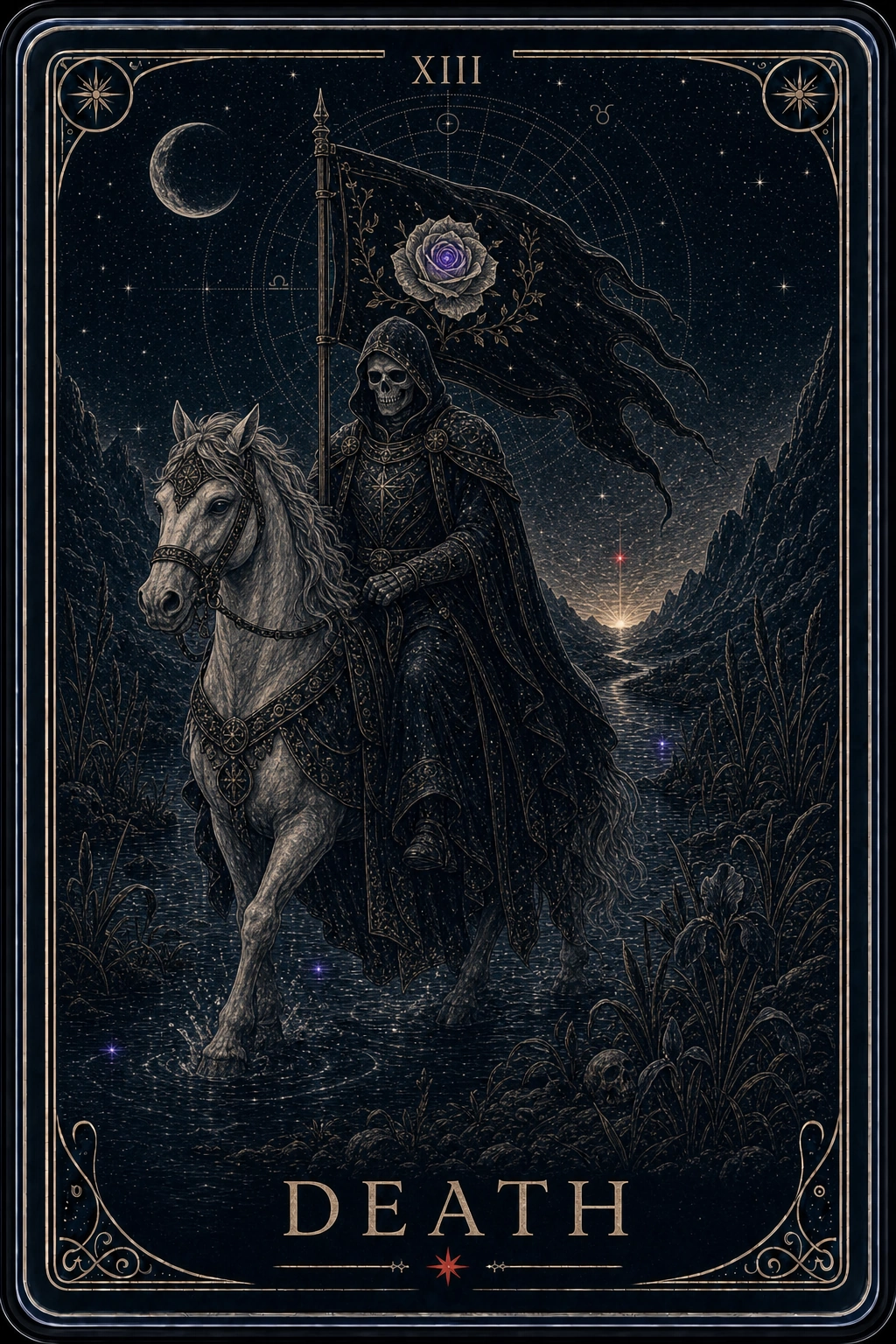
In One Line
It isn't ending. It's finished — and those are different things.
What Death Names
Death names completion arriving whether or not it was invited. Not failure — failure is when something breaks. Death is when something finishes: the role fully played, the chapter fully written, the version of you fully used. The card's arrival almost always lags the actual ending. The thing was over first. Death is just the notice.
What makes this card merciful, under its reputation, is its honesty about where the pain lives. The ending itself is usually painless — it already happened, quietly, while attention was elsewhere. The pain is in the carrying: hauling a finished thing forward month after month because putting it down feels like betrayal, or like admitting time has passed. Death names the moment the carrying costs more than the grief would.
And it insists, against every fear, that this is a crossing and not a wall. Something continues — changed in form, stripped of what was only costume. The card has never once meant nothing comes next.
On This Card
The Night Glass rider crosses a river — he is in the water, mid-ford, which is the deck's most deliberate choice on this card. Not standing at a gate. Not looming. Crossing. Death here is a passage with a far bank, and the far bank is visible.
Behind him, along the horizon, the sky is lightening — the single warm glow in one of the deck's darkest images, with one red star burning in it. The card does not ask you to take the dawn on faith. It paints it.
The banner he carries is black, and on it blooms a single luminous rose: what survives every crossing, carried openly, on the darkest possible ground. The horse is pale and calm — this passage is routine to the passage. And down among the reeds, a skull half-hidden in the growth: the last crossing, already overgrown, already feeding what came after. The card shows you the whole cycle in one riverbed.
The Inverted Pattern
Running blocked, Death becomes the refused crossing: the finished thing kept on life support — the role performed after it ended, the relationship curated like a museum of itself, the old self's costume worn because the new one isn't sewn yet. The river doesn't dry up while you wait; it just gets colder. The inverted question: what in your life is already over — and how long have you known?
When It Finds You
Death tends to appear when a chapter has ended administratively but not emotionally — the job left, the papers signed, the grief still unscheduled. It appears when you catch yourself performing a self that used to be true. And it appears, gently, in seasons of moulting: nothing dramatic, just the growing certainty that the current form has finished its work and something in you is already packing.
The Lineage
The unnamed card — many early decks would not print the word, numbering it thirteen and letting the image speak. The rider, the pale horse, the crossing: painted for centuries that lived closer to endings than ours does, and understood them better as what they are. Passage. The decks that feared the word never feared the card.
The Signal Door
What it names in you is different.
This is what Death means in general. What it names in you is a different question.
The Signal reads one card for you — your name, where you actually are, and a pattern named with precision. It opens once per person.