Minor Arcana · Pentacles
Knight of Pentacles
In One Line
Every other knight in this deck is moving. This one has stopped his horse to look at the coin properly. He will also be the only one who's still riding in ten years.
What Knight of Pentacles Names
The Knight of Pentacles names commitment at working speed — the suit's energy in motion, which in earth's case means barely, steadily, and without end. He is the deck's long-hauler: the one who ploughs the same field the hundredth time with the same care as the first, keeps the promise made in an exciting month through eleven boring ones, and arrives — always, eventually, provably — because arriving was never in question, only the date.
The card defends him from the glamour of the other knights. Cups courts, Wands charges, Swords drives; this one maintains — and maintenance is the most underpainted heroism in the deck. Every structure the suit builds, from the Eight's wall to the Ten's arch, stands on years of exactly this figure doing exactly this: the unbrilliant, repeated, load-bearing next thing.
Its edge is honest: reliability can calcify. The route kept after the destination changed, the method defended against every improvement — the Knight's virtue, aged badly, becomes the rut. The card asks him one question on schedule: still the right field?
On This Card
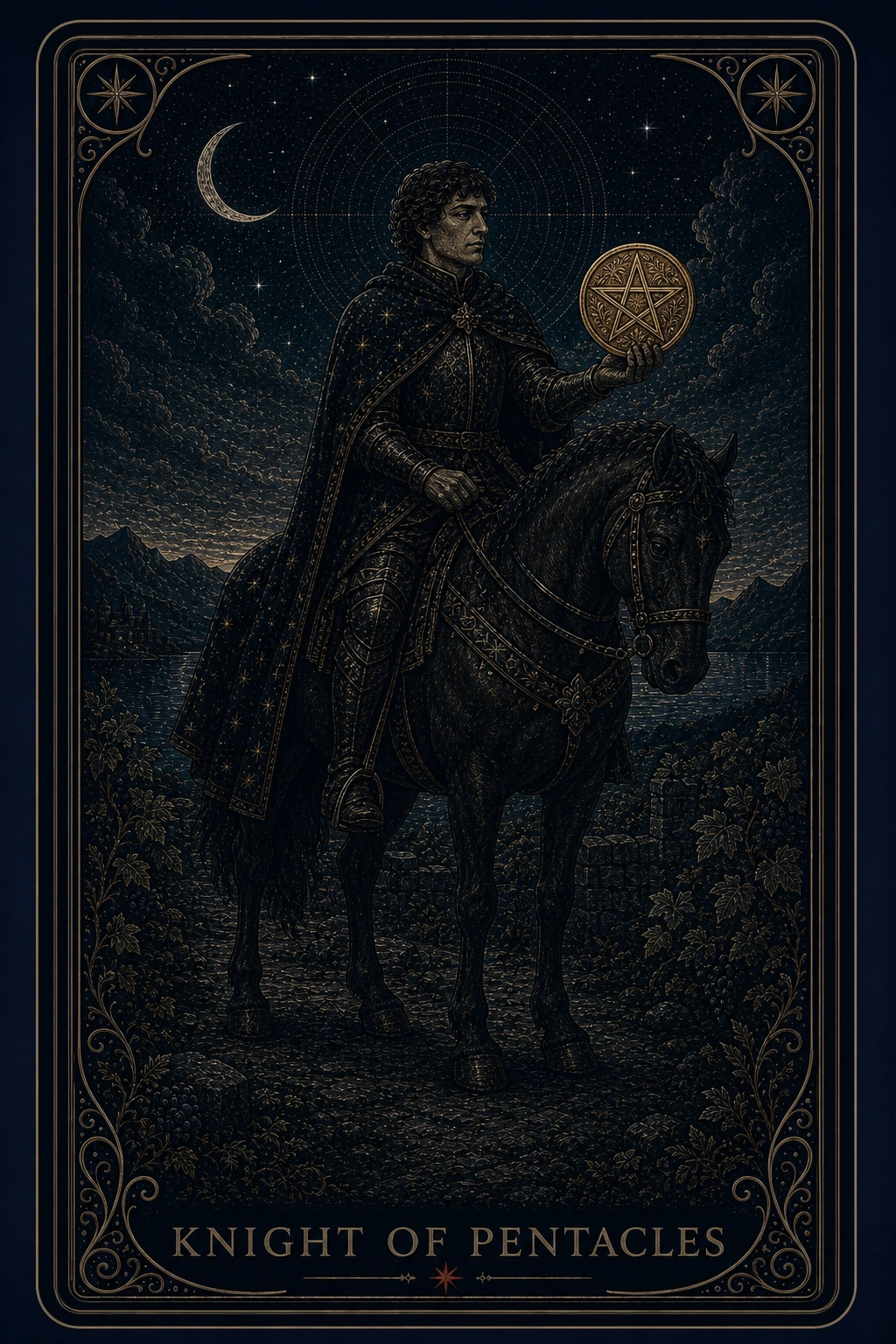
The Night Glass horse is halted — fully, deliberately, all its weight settled, head lowered and calm. In a deck where every other knight's mount is mid-motion, the deck stopped this one on purpose and let the stillness carry the meaning: this is the only knight secure enough to stand still in open country. Nothing about the pause is hesitation. It is inspection.
He holds the coin out on one flat, steady hand — not clutched like the Four, not cradled like the Page. Presented level, at arm's length, examined in the open air. The working grip: firm enough to keep it, loose enough to weigh it. Between the halted horse and the level coin, the card is one sustained act of quality control.
Around him, the deck planted vineyard — trained rows, a low stone wall, grape clusters in the margins. Not wilderness, not garden: working land, mid-season. The Knight of Pentacles is the only knight the deck placed inside cultivation, because he is the only one who'd notice the difference.
The Inverted Pattern
Running blocked, the Knight becomes the rut with a rider: motion so slow it has quietly become none — the diligence continued past its purpose, the field ploughed because ploughing is what's known, every change resisted as a threat to the one virtue held. Reliability curdles into refusal. The inverted question: when did you last verify that this field, this route, this method still leads anywhere — or has the faithfulness itself become the destination?
When It Finds You
The Knight of Pentacles tends to appear when the work ahead is long and unglamorous and worth it — the card deputizes you for the middle miles. It appears around a person of this build: slow to excite, impossible to stop, worth more than three brilliant starters. And it appears as a schedule check for the steady: hold the pace, and once a season, halt the horse and inspect the coin.
The Lineage
The knight of the coins was always the odd one in the court — painted for six centuries on a standing horse while his brothers charged, the workhorse cavalier of a suit that knew where harvests actually come from. The old decks gave him the heaviest mount and the shortest journey per card and the most arrivals per lifetime. The painters were keeping books. They knew who paid for the paint.
The Signal Door
What it names in you is different.
This is what Knight of Pentacles means in general. What it names in you is a different question.
The Signal reads one card for you — your name, where you actually are, and a pattern named with precision. It opens once per person.