Major Arcana
VII — The Chariot
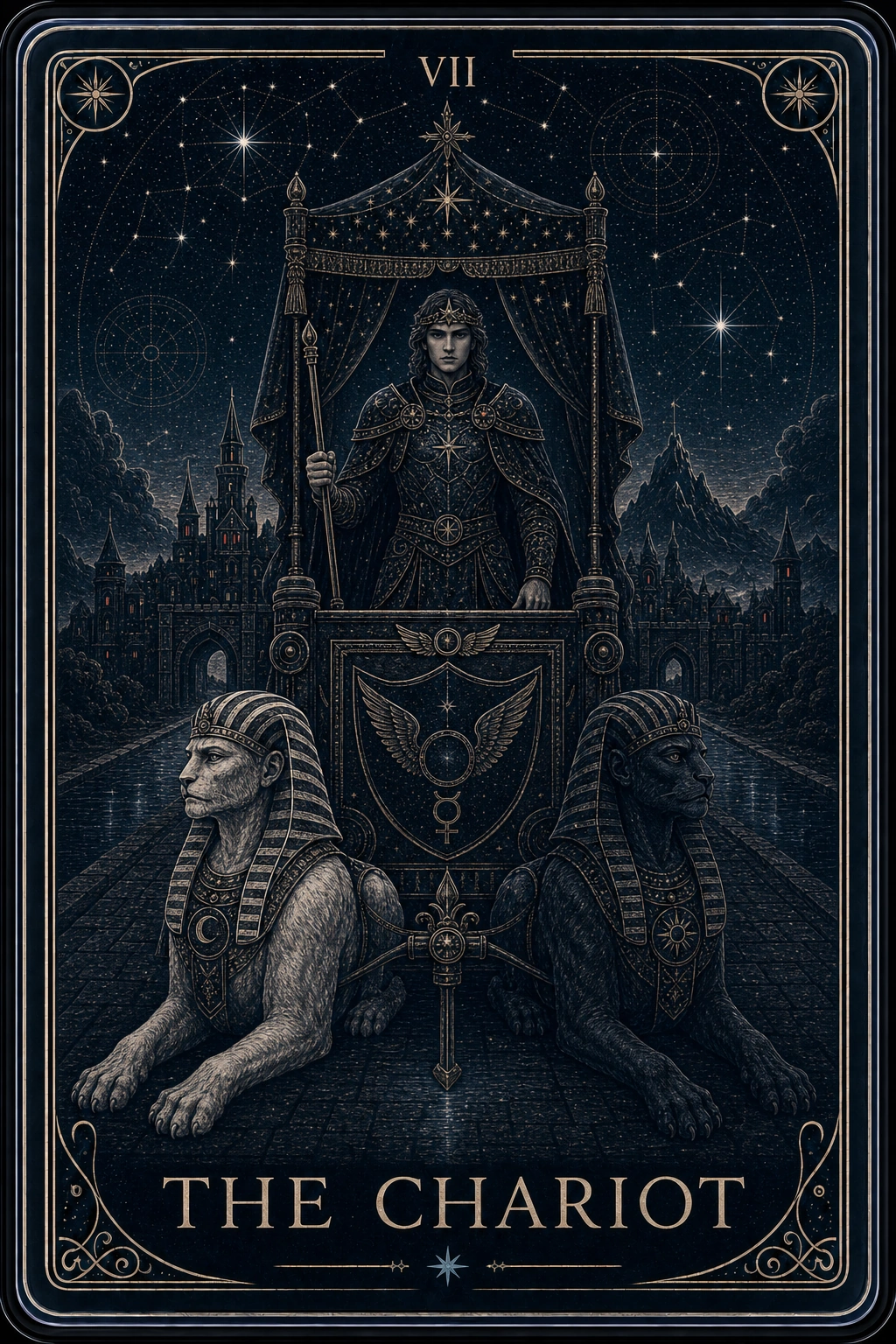
In One Line
You don't need the parts of you to agree. You need them harnessed to the same road.
What The Chariot Names
The Chariot names motion that doesn't wait for unanimity. It is the card of the person who has stopped holding a referendum — who has ambition and doubt, hunger and fear, the part that wants to be seen and the part that wants to hide, and who moves anyway, with all of it aboard.
Its central correction is aimed at a common and expensive belief: that inner conflict disqualifies you from direction. People stall for years waiting to feel one way about the thing — fully confident, fully ready, internally resolved. The Chariot's answer is its own image: the forces never merge. They face different directions the entire ride. Victory is not their agreement; it is their harness — one road, chosen by the one who holds the reins, with every opposing force contributing its pull.
And it names will as a quieter thing than its reputation: not the white-knuckle grip, but the daily re-choosing of the road. The charioteer's power is not that he never hears the argument. It is that the argument no longer drives.
On This Card
The Night Glass sphinxes are lying down — and they face opposite directions, exactly as the oldest versions insist. One pale, one dark, both at rest, both still harnessed. The deck's point is easy to miss and worth the whole card: the opposing forces are not straining. Integration, done right, is not a permanent wrestling match. The tension has been accepted into the design, and the design holds.
The charioteer stands — no seat in a chariot of black glass. Direction is not a passenger's posture. And notice what the deck withheld: there are no reins. His hands hold a staff, not straps. Whatever commands these forces, it is not leverage. It is the standing itself.
Above him, the canopy is sewn with stars — a piece of sky he carries over his own head, the guidance internalized and traveling with him. And on the chariot's front, a winged emblem over the glyph of Venus: the journey is armored, but what it protects at the center is not a weapon. The card has a soft cargo. That is why the road matters.
The Inverted Pattern
Running blocked, The Chariot is the vehicle pulled apart: one sphinx fed, the other starved, until the starved one bolts — the ambition that ran over the body, the discipline that snapped into indulgence. Or it is the parked life: forces balanced so carefully against each other that nothing moves, neutrality mistaken for peace. The inverted question: which of your opposing forces has been doing all the pulling — and what is the ignored one preparing to do about it?
When It Finds You
The Chariot tends to appear when you're waiting to feel unanimous before starting — the decision postponed until the doubt retires, which it never does. It appears mid-campaign, when the road is right and the forces are fraying, as a reminder that the harness needs tending, not the destination. And it appears at genuine departures: the move, the launch, the leaving, when everything you are climbs aboard whether it voted yes or not.
The Lineage
The triumphal chariot rolled straight out of Renaissance Italy's actual streets — the trionfo, the victory parade, painted into the deck by courts that staged them. The centuries swapped horses for sphinxes and made the card honest: the forces that draw a real life forward are never a matched team.
The Signal Door
What it names in you is different.
This is what The Chariot means in general. What it names in you is a different question.
The Signal reads one card for you — your name, where you actually are, and a pattern named with precision. It opens once per person.