Minor Arcana · Swords
Page of Swords
In One Line
The wind is the teacher, the watching is the coursework, and the sword is not ready to swing yet. Neither are you — which is exactly right.
What Page of Swords Names
The Page of Swords names the mind at the apprentice stage — intelligence that is quick, hungry, vigilant, and not yet load-tested. The new framework applied to everything. The question asked one layer past politeness. The watchfulness of someone who has just learned that words are blades and is carrying their first one everywhere, looking for something to try it on.
The card honors what this stage does that mastery can't: it sees freshly. The Page hasn't learned what everyone knows, so he notices what everyone missed. His restlessness is a sensor array — the turned head, the tracked conversation, the appetite for information that older minds have rationed down. Every breakthrough in a life has a Page of Swords phase, and the card defends it.
What it names honestly is the stage's edge: a blade carried by someone still learning its weight cuts bystanders. The too-sharp comment, the analysis delivered where comfort was needed, the truth told with beginner's aim. The Page's curriculum is not the sword. It is the timing.
On This Card
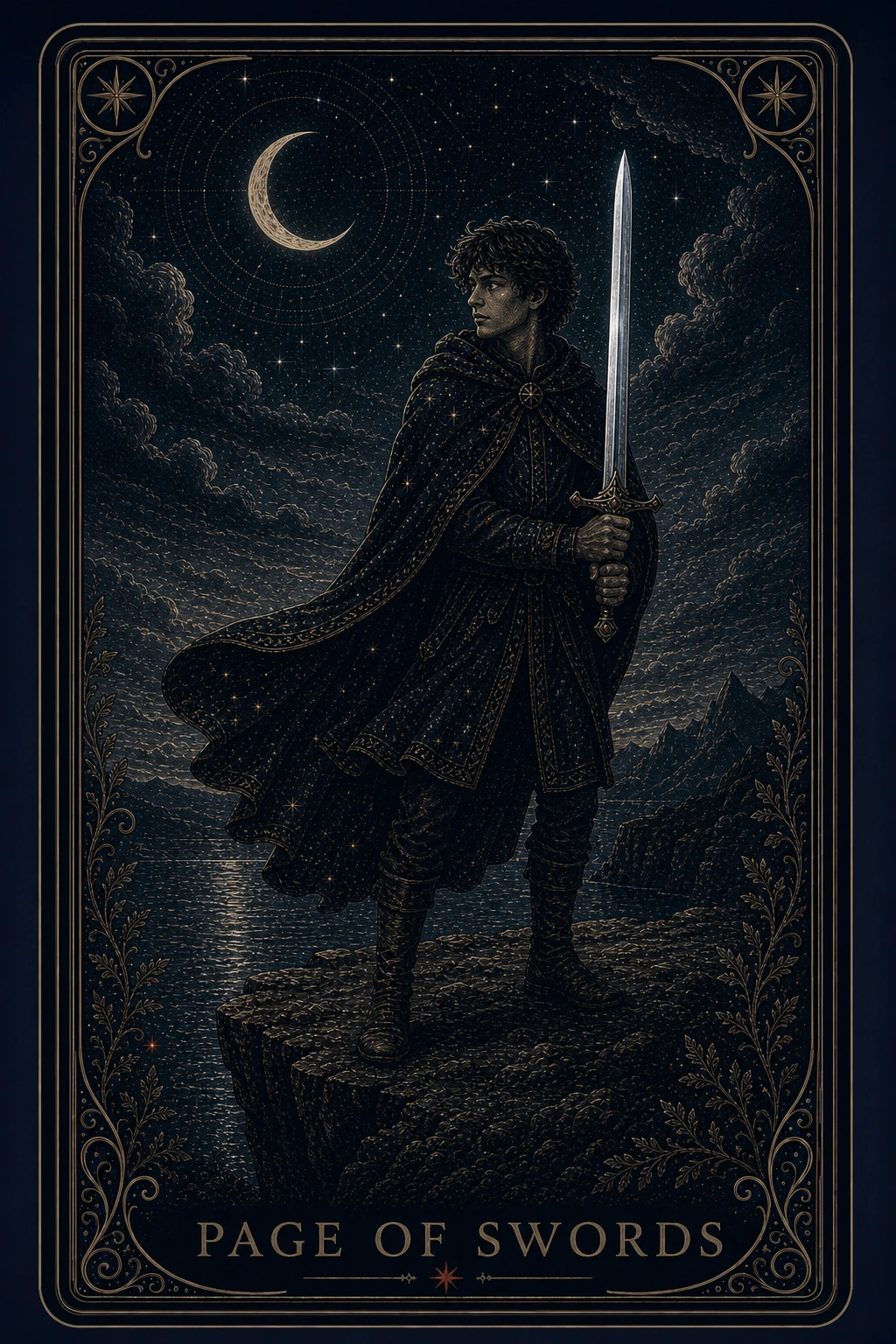
The Night Glass Page holds his sword in both hands — upright, close to the body, studied rather than brandished. The deck's courts each learn their emblem, and this one is mid-lesson: the grip is correct, the stance is high ground, and nothing is being swung. The blade between his hands is the brightest thing on the card, the way a new understanding is the brightest thing in a young mind.
The wind owns the composition. His cloak streams full out to one side, the clouds run, the water below is rough — the suit's element, air, at working strength. And he stands into it, on the edge of his rock, head turned to watch something off-card. The deck's apprentice of the mind is drawn doing the whole job of this stage: holding steady in moving information, attention pointed outward.
He watches one direction while the wind comes from another. Not an error — the lesson itself. Minds at this stage learn that the interesting thing and the incoming thing are rarely the same thing.
The Inverted Pattern
Running blocked, the Page becomes surveillance without synthesis: the watching turned anxious, every room scanned, every message parsed twice, information gathered as armor and never as understanding. Or the blade swung early and often — the smart remark as a reflex, cleverness spending what wisdom hasn't earned yet. The inverted question: is your vigilance in service of learning something — or of making sure nothing ever reaches you unannounced?
When It Finds You
The Page of Swords tends to appear at the start of a mental apprenticeship — the new field, the new framework, the season of questions. It appears when word arrives that rewards a sharp read. And it appears as placement advice: you're at the studying stage of something, and the card's counsel is to stay there honestly — watch longer, swing later.
The Lineage
The pages of the first Italian courts were exactly this figure — the young ones posted to watch, carry word, and learn the weapon by holding it, not using it. The Page of the blades was always painted on high ground with weather in his clothes: the courts knew that minds are trained in moving air, and they drew the training conditions accurately.
The Signal Door
What it names in you is different.
This is what Page of Swords means in general. What it names in you is a different question.
The Signal reads one card for you — your name, where you actually are, and a pattern named with precision. It opens once per person.