Minor Arcana · Swords
Knight of Swords
In One Line
You already know where you're going. The charge is correct. Just check, once, at speed: toward the thing — or just away from the standing still?
What Knight of Swords Names
The Knight of Swords names the mind at full commitment — thought converted to velocity. The decision that mobilizes everything, the argument carried to its door, the truth that will be delivered today by hand. Where the Page watches, the Knight closes distance: this is the suit's courier of conclusions, and he does not do drafts.
The card respects the build. Minds of this voltage end stagnations that gentler speeds never would — the overdue confrontation, the cause that needed a champion by Thursday. When the moment genuinely calls for someone to cut through, the Knight of Swords is what cutting through looks like, and the deck refuses to apologize for him.
What it audits is the targeting. At this speed, conviction and momentum become indistinguishable from inside the charge — and a mind moving this fast can be absolutely certain and aimed slightly wrong, arriving with full force at a point six degrees from the true one. The Knight's discipline is not slowing down. It is the mid-gallop check: aim, verified against something other than the thrill of the riding.
On This Card
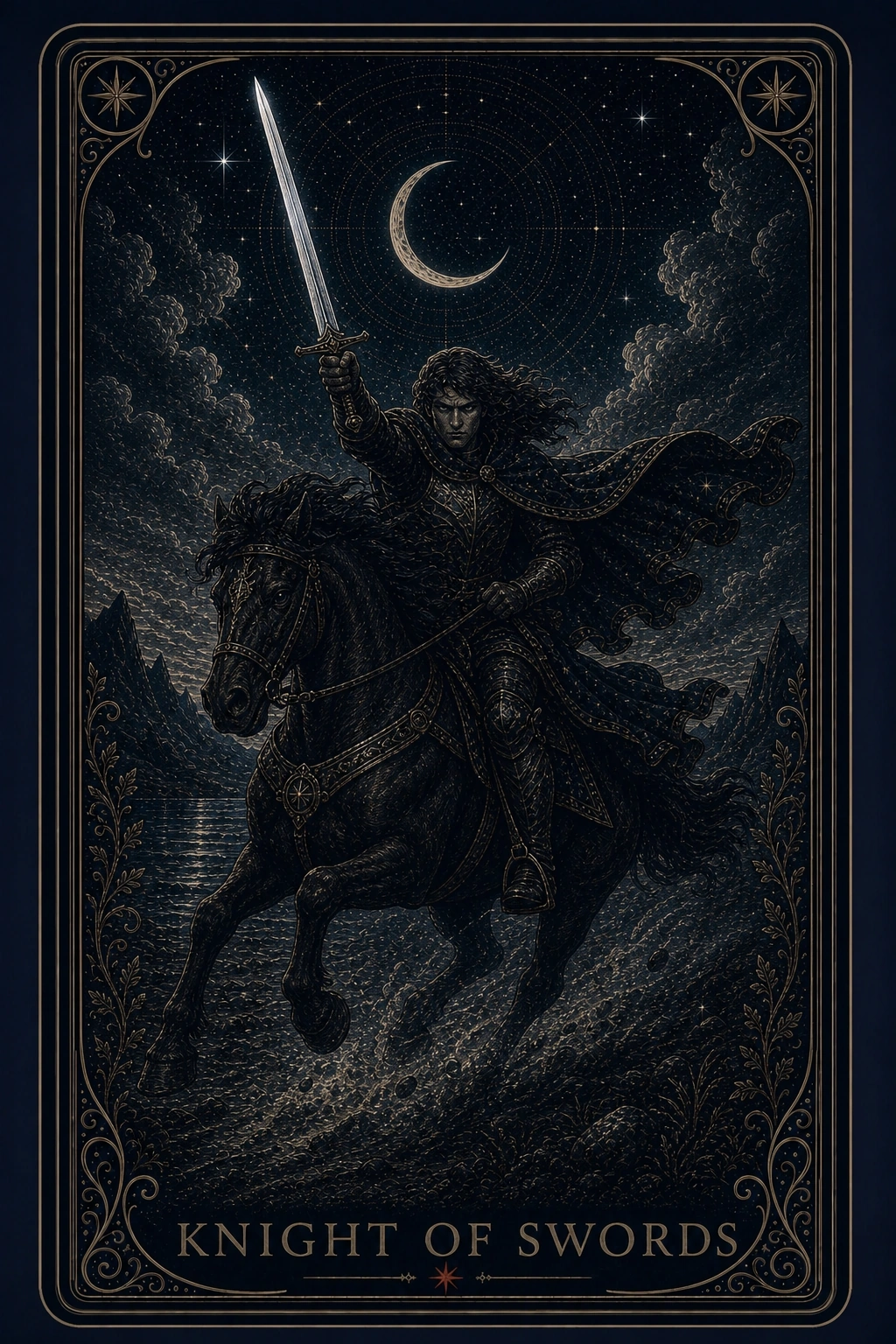
The Night Glass horse is black and fully committed — forelegs off the ground, mane and rider's hair streaming into the same wind, the ground beneath churned to spray. The deck gave the suit of air its one storm-animal: where the Cups knight processes and the Wands knight blazes, this one drives, and the card's texture — cloak, cloud, and churned earth drawn almost as one material — says the rider and the weather have merged.
His sword is raised to full extension, tip into the sky's drawn rings — the blade at maximum reach, answering the crescent above it. And his eyes: the card's stillest point. In all that motion, the gaze is locked, level, dead ahead. The deck permits no wildness in the face. This charge has a destination, and the destination has already been chosen. That is either the card's greatest strength or its entire risk, and the deck — honestly — draws it as both.
Nothing else is on the road. The landscape gives him mountains, water, sky, and no visible opponent: the deck leaves the target off-card, where it leaves every question that only the rider can answer.
The Inverted Pattern
Running blocked, the Knight splits two ways: the charge with no verified target — force as a lifestyle, every issue met at full gallop, truths delivered for the relief of delivering them — or the charge never launched, the conviction raised like the sword and held there, waiting for a certainty that riding is the only way to reach. The inverted question: this thing you're about to do at full speed — if the pause cost you nothing, would you still choose this exact door to arrive at?
When It Finds You
The Knight of Swords tends to appear when something has waited long enough — the conversation, the decision, the send button. It appears mid-charge, as the aim-check: full speed, one verification. And it appears around a person of this voltage entering your week — bracing, useful, and best met the way the card is read: honor the force, audit the direction.
The Lineage
The charging cavalier of the blades has ridden through six centuries of decks at this exact speed — the courts that painted him ran on riders like this, the ones sent when the message could not wait for morning. Every era has needed him and every era has learned his one flaw the same way. The painters kept the eyes locked forward. The question of the target they left, faithfully, to the rider.
The Signal Door
What it names in you is different.
This is what Knight of Swords means in general. What it names in you is a different question.
The Signal reads one card for you — your name, where you actually are, and a pattern named with precision. It opens once per person.