Minor Arcana · Swords
Six of Swords
In One Line
The swords come in the boat. That's allowed. The crossing happens anyway.
What Six of Swords Names
The Six of Swords names the quiet crossing — the passage out of a hard chapter, made not in triumph but in low water and silence. Nobody on this card is celebrating. This is what actual leaving looks like most of the time: undramatic, tired, forward. The storm is behind, the far shore is real, and the distance between them is covered one pole-push at a time.
What the card rules on, gently and permanently, is the luggage question. The six swords ride in the boat. Everything learned in the hard chapter — the sharpened wariness, the accurate conclusions, the memories with edges — comes along, standing upright in the hull for the whole crossing. The Six never asks you to arrive clean. It asks you to arrive.
And it honors the ferryman — the one who does the work of the transition. Sometimes another person. Often the part of you that stands up, takes the pole, and moves the boat while the rest of you sits with the child and the grief.
On This Card
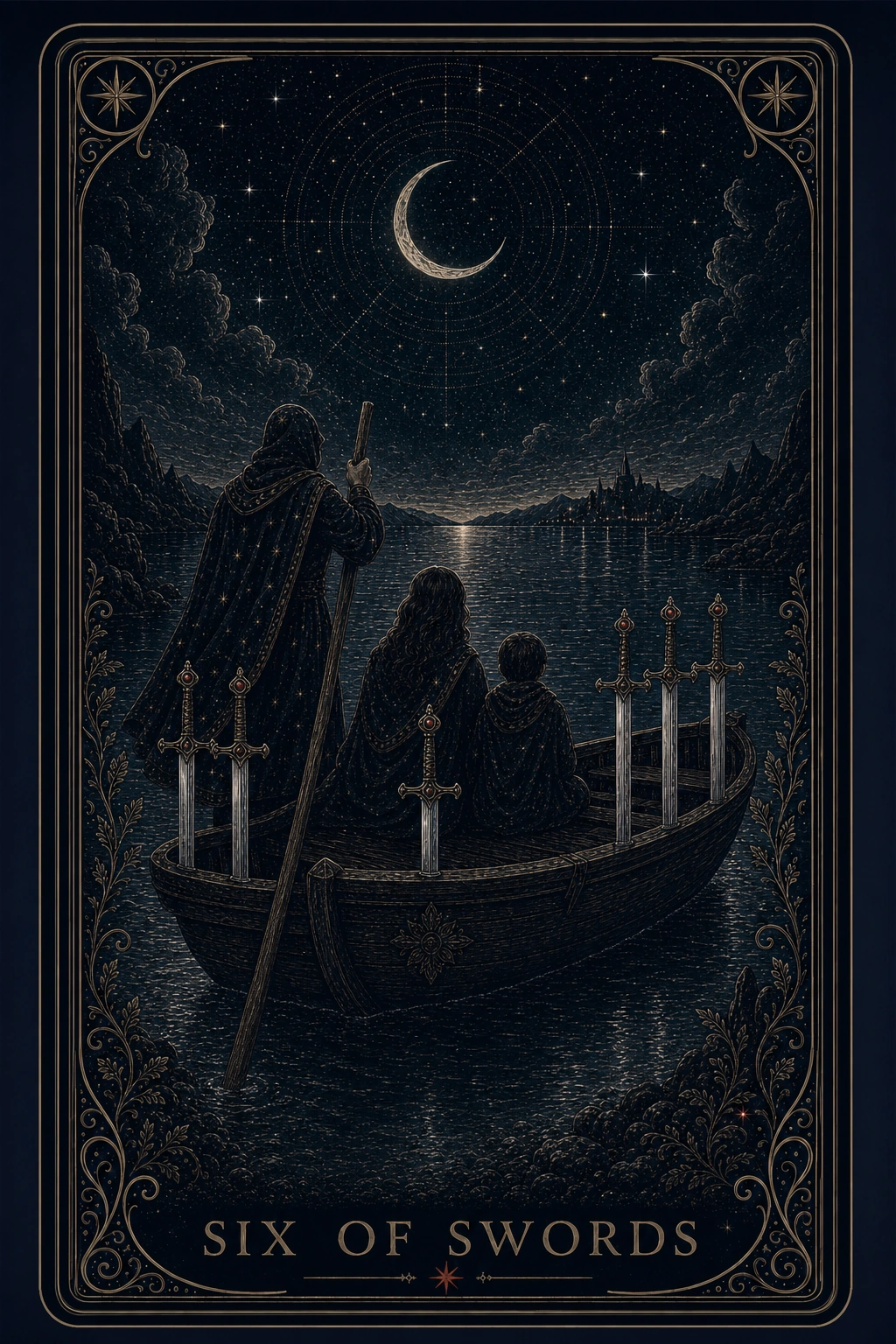
The Night Glass swords stand blades-down in the boat's hull — planted, upright, six silent passengers with red jewels in their pommels. The deck's boldest claim on this card: the cargo is not dragging the boat down. Set upright and carried properly, the very steel from the old chapter becomes part of the vessel's structure for crossing to the new one.
The passengers face away, all three — the poler standing, the woman and small one seated low and close. Nobody looks back, and the deck grants nobody a face. This card is every crossing, and its passengers are whoever is currently in the boat.
Ahead, across the calm water: the far city, lit — warm points of light with a soft glow on the horizon line, reflected all the way back toward the hull. The destination on this card is never in doubt. Only the distance is, and the deck draws the water between as already crossable: flat, quiet, holding the light.
The Inverted Pattern
Running blocked, the Six becomes the circling boat: the departure begun and never landed — physically gone from the hard chapter, mentally still ashore in it, the crossing extended indefinitely because arriving would make the new life real and accountable. Or the crossing refused outright: the boat loaded, poled by no one. The inverted question: you left — but have you landed? And what's the difference, for you, between the two?
When It Finds You
The Six of Swords tends to appear mid-transition — the move made, the papers signed, the quiet weeks of actually becoming elsewhere. It appears when a departure is overdue and awaiting drama that isn't coming: some chapters end without a scene, in low water, on a Tuesday. And it appears as a word for the tired: this slowness is the crossing working. Keep poling.
The Lineage
The ferry of souls is older than the deck itself — the poled boat, the silent passengers, the far shore. The Renaissance painted its waterways daily; every city of canals and lagoons knew the boatman who carried people between lives. The card gave the oldest crossing in human imagery a gentler cargo and kept its promise: the far bank receives everyone who stays in the boat.
The Signal Door
What it names in you is different.
This is what Six of Swords means in general. What it names in you is a different question.
The Signal reads one card for you — your name, where you actually are, and a pattern named with precision. It opens once per person.