Major Arcana
IV — The Emperor
In One Line
Your power isn't leaking because it's weak. It's leaking because it has no walls.
What The Emperor Names
The Emperor names the container. Not power itself — the deck has other cards for raw current — but the structure that keeps power from draining away: the boundary, the schedule, the standard, the word that means what it said. He is the least romantic card in the Majors and one of the most quietly lifesaving, because he names the thing talented, generous, overflowing people most often lack.
His diagnosis lands hard on a certain kind of person: enormous capability, no walls. The calendar everyone else writes on. The prices that apologize. The yes that comes out before the question ends. The Emperor watches all of it and names the pattern beneath: power without structure doesn't accumulate — it irrigates everyone else's fields.
And he redeems a word his card has been blamed for. Authority, made clean, is not domination; it is authorship — the willingness to be the one who decides, and to stand where the deciding can be seen. Every boundary he asks you to build is in service of one thing: that what you generate finally stays yours to direct.
On This Card
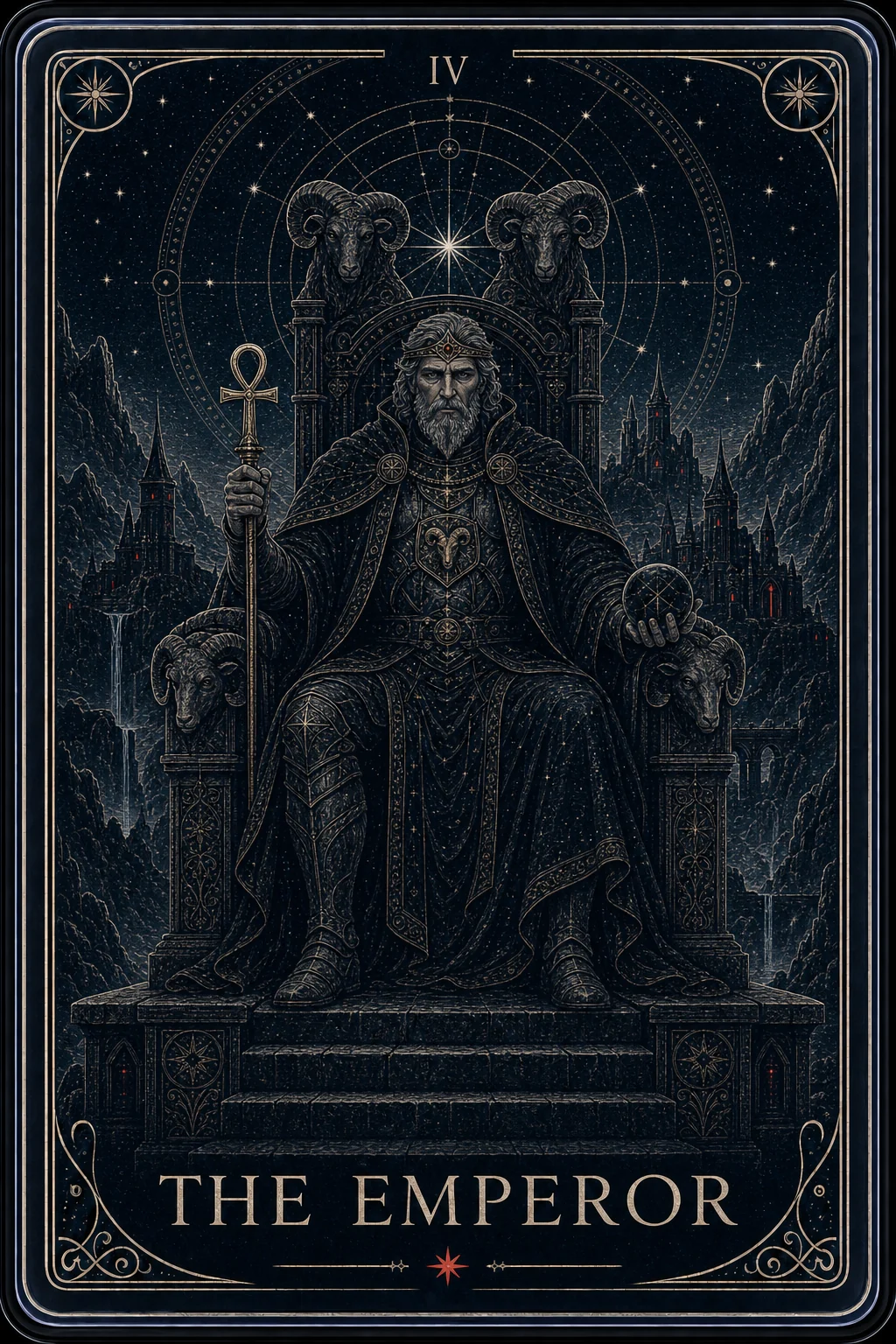
The Night Glass Emperor's throne is cut from black stone, and it is carved — ram heads at the shoulders and the armrests, force taken into the structure itself. The deck's point is precise: he did not get rid of the ram. He built with it. The charge that runs wild in other cards is load-bearing here.
In one hand, the ankh-headed scepter — the old sign of life — and in the other, a dark orb. Life in the right hand, the weight of the world in the left, and look at the grip: the orb is held, not clutched. Rule, on this card, is carrying capacity.
Behind him the mountains are severe and the citadels in the far valleys show tiny lit windows — red points in the black. What he built is inhabited. That is the detail that answers every accusation the card has ever faced: the walls were never for keeping life out. They are what lets life burn safely inside.
The Inverted Pattern
Running blocked, The Emperor fails in both directions: the fortress with no doors — control hardened into rigidity, structure serving itself, the schedule that survived its purpose — or no fortress at all, the sovereignty outsourced, the kingdom run by whoever asks loudest. The tell for the second failure is exhaustion that no rest fixes, because the leak is structural. The inverted question: where in your life does everything you build drain out as fast as you build it — and what wall have you been refusing to put up, and to please whom?
When It Finds You
The Emperor tends to appear when the gift is real and the container isn't — the thriving work with no contracts, the generosity with no hours, the talent priced by other people's comfort. He appears at the moment a season of flow needs a spine: the growth that will collapse without systems under it. And he appears when authority is being offered and dodged — the role you keep half-refusing because deciding means being seen deciding.
The Lineage
Enthroned since the first Renaissance decks beside his growing counterpart the Empress — the courts that painted him knew both truths and kept both cards. Some things are grown. Others must be built, walled, and held. Six centuries have not produced a kingdom that survived on growth alone.
The Signal Door
What it names in you is different.
This is what The Emperor means in general. What it names in you is a different question.
The Signal reads one card for you — your name, where you actually are, and a pattern named with precision. It opens once per person.