Major Arcana
XI — Justice
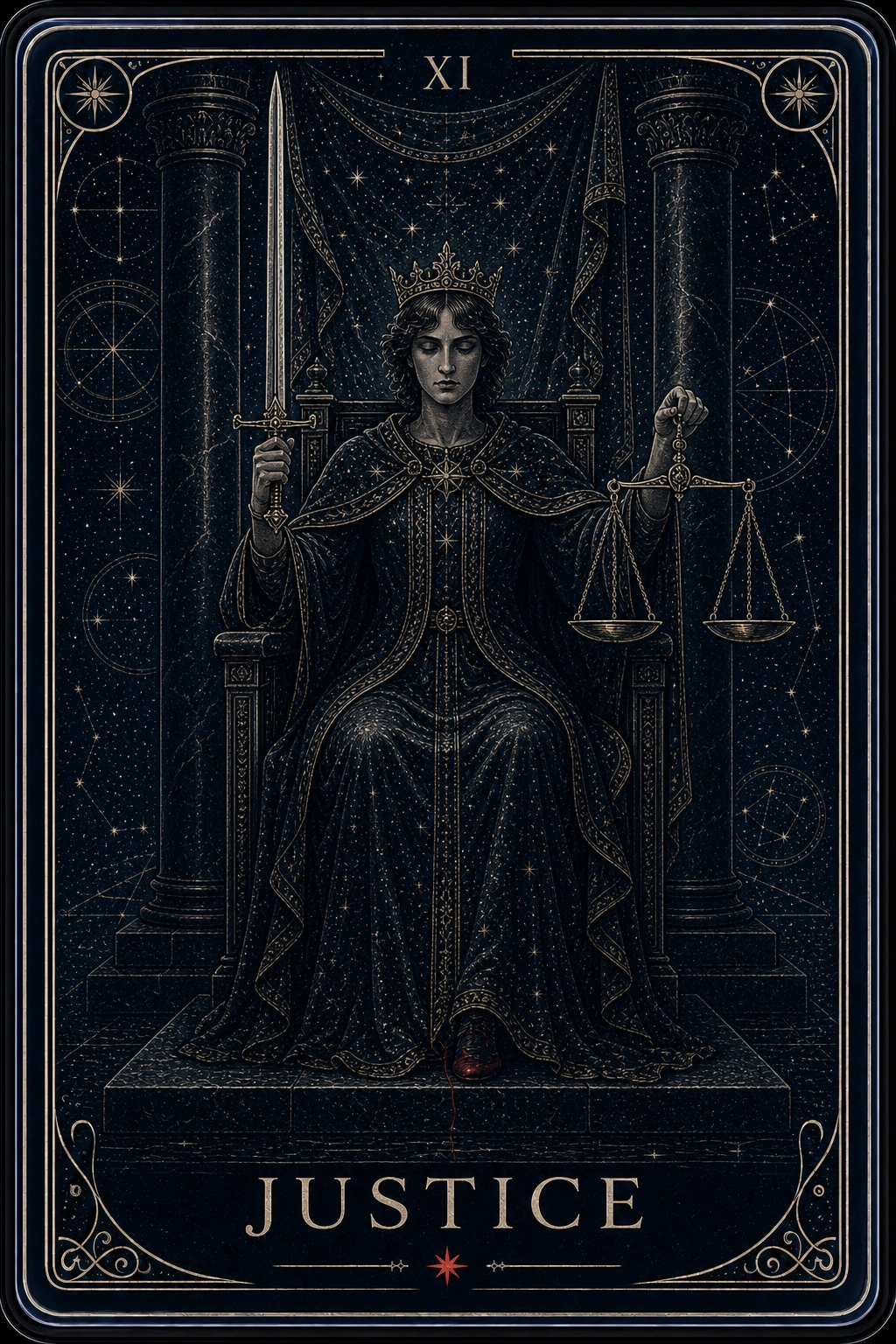
In One Line
The truth you're avoiding isn't a punishment. It's the line that ends the loop.
What Justice Names
Justice names the moment accuracy becomes available. Not fairness as the child means it — the universe balancing every ledger — but the adult version: the clean account of what actually happened, what was actually yours, what was actually theirs, drawn without flinching in either direction.
The card's central claim is that this accuracy is a mercy, not a sentence. Patterns repeat on fuel, and their favorite fuel is distortion — the story softened to protect someone, the blame absorbed to keep a peace, the grievance inflated until it can carry a whole identity. Justice arrives with a blade and a balance and does the one thing that stops a loop: she weighs it true. Whatever the scales say, the saying ends the repeating. Loops cannot survive being accurately described.
And she names responsibility in its liberating form. Taking your exact share — no more, which is martyrdom, and no less, which is evasion — is how a person gets their hands back on the wheel. What was truly done to you, you can grieve. What you truly did, you can change. Justice's gift is knowing, at last, which is which.
On This Card
The Night Glass Justice wears a veil across her eyes — and holds the scales perfectly level anyway. The deck's argument in one image: true weighing was never done by looking. Faces, histories, charm, the special case you'd plead — the veil retires all of it. What remains is weight.
Her sword is upright. Not raised to strike, not lowered in mercy — vertical, at rest, the blade as plumb line. This card's sword is an instrument before it is a weapon: it exists to draw the one straight line through the tangle. Most tangles, the card suggests, are cut by nothing more violent than a truth held steady.
She sits exactly between the black pillars, centered to the millimeter — the only figure in the deck placed with that geometric severity. The composition is the verdict: the center holds because someone is willing to sit in it, unswayed by either side's pull.
The Inverted Pattern
Running blocked, Justice becomes the rigged scale: the account that always finds you innocent — every ended relationship a gallery of their failures — or the one that always finds you guilty, every weather event somehow your doing. Opposite verdicts, same corruption: the weighing done in advance. The inverted question: in the story you tell about the thing that still hurts — what have you left off the scale, and which pan does the missing weight belong to?
When It Finds You
Justice tends to appear when a reckoning is available and being postponed — the honest accounting of a relationship, a business, a decade, waiting on your willingness to look. She appears around actual agreements: contracts, settlements, the terms that will hold only if they're true. And she appears when you've been living inside a story with the weights moved — the card's counsel is never shame, only accuracy: weigh it again, all of it, and watch the loop lose its fuel.
The Lineage
She predates the deck itself — sword and scales, one of the four cardinal virtues Renaissance Italy painted everywhere it painted anything. The centuries added her veil and completed the thought: the weighing that can be swayed by what it sees was never justice. The oldest card in spirit, and the least changed.
The Signal Door
What it names in you is different.
This is what Justice means in general. What it names in you is a different question.
The Signal reads one card for you — your name, where you actually are, and a pattern named with precision. It opens once per person.