Minor Arcana · Swords
Five of Swords
In One Line
You have the swords. They have each other, and they're leaving. Count again who won.
What Five of Swords Names
The Five of Swords names the victory that costs the war's whole point — the argument won so thoroughly that the relationship left the field. The last word, secured. The point, proven. The room, empty. It is the suit's audit card: swords keep score in being right, and the Five is where being right posts its true price.
The card's genius is that it convicts no one. The winner isn't a villain — he's usually the sharper mind, the better debater, often the one who was technically correct. The Five doesn't dispute the verdict. It shows the settlement: three swords gathered that can't be used for anything, two abandoned that no one will return for, and the only people who knew this battlefield walking somewhere warmer.
And it names the aftermath's specific temperature — that hollow, over-the-shoulder feeling of a win that will need to be justified to yourself later tonight. The card catches the justifying before it hardens.
On This Card
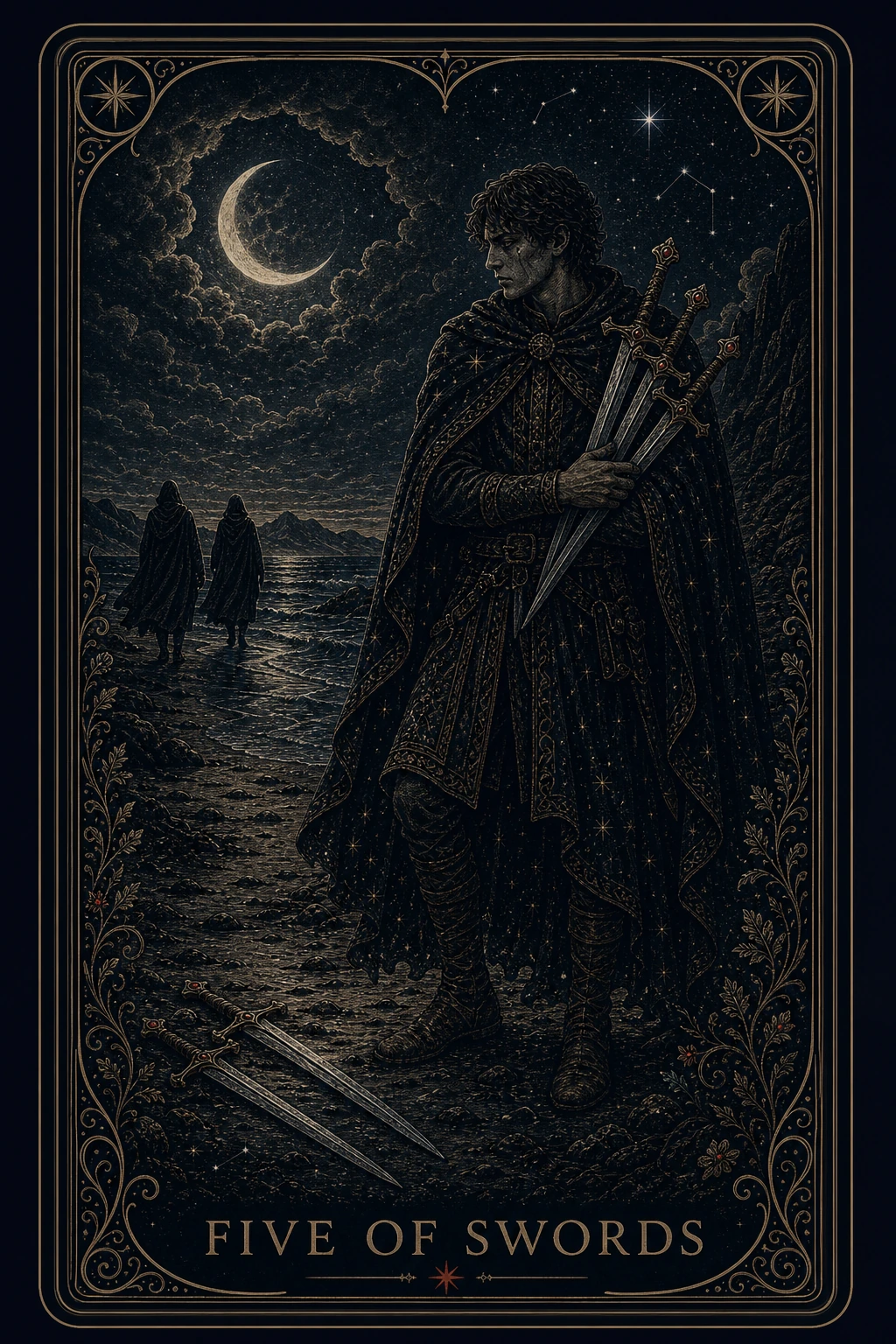
The Night Glass winner is not gloating. The deck broke with centuries of smirking victors and drew him glancing back — face troubled, something like a tear-track on the cheek — at the two figures departing along the shore. He is watching the actual outcome leave. The swords are gathered against his shoulder like firewood, and his eyes are on the people. The card's entire verdict is in where his attention went the moment the winning was done.
The two departing figures walk close together, hooded, side by side into the moonlit distance. They lost the exchange. They leave with each other. The composition does the arithmetic without a word.
And at his feet, two swords lie abandoned on the dark ground — points he made that no one stayed to concede. Arguments won against the departed convert instantly into this: metal on the ground, and the sound of the tide.
The Inverted Pattern
Running blocked, the Five becomes the career of being right: every room a battlefield, every exchange scored, the gathering of conceded points mistaken for a life — while the people inventory quietly empties. Or its mirror: always the one walking away, every conflict forfeited to stay likable, the field abandoned before your own point ever gets made. The inverted question: in your last three conflicts, what did you actually walk away holding — and would you trade it back for what walked away?
When It Finds You
The Five of Swords tends to appear just after a hollow win — the argument you're still re-winning in the shower, days later, to an audience of none. It appears before one: a fight is coming that you will technically win, and the card arrives early to ask whether the field is worth the taking. And it appears in long relationships as a ledger check: who's been collecting swords, and who's been walking?
The Lineage
The battlefield's aftermath — painted since the early decks as one figure among gathered blades while others withdraw. The centuries that made these cards fought duels over exactly this: honor, insult, the point of pride pressed to steel. They knew the Five's lesson at sword-point and painted it for the rest of us to learn cheaper.
The Signal Door
What it names in you is different.
This is what Five of Swords means in general. What it names in you is a different question.
The Signal reads one card for you — your name, where you actually are, and a pattern named with precision. It opens once per person.