Minor Arcana · Swords
Seven of Swords
In One Line
The move is working. That was never the question. The question is who you have to keep being for it to keep working.
What Seven of Swords Names
The Seven of Swords names the indirect route — strategy that declines to announce itself. The taken advantage, the unshared plan, the exit made quietly while the camp sleeps. And its first act is to refuse the easy verdict: this card is not simply the thief. Sometimes the seven's maneuver is survival — discretion in a room that punishes honesty, the quiet departure from a place where a declared one would be stopped.
What it names without mercy is the cost structure. Every indirect move creates a maintenance contract: the story that must stay straight, the version of events that must be managed, the backward glance that becomes a permanent feature of the neck. The card's figure is mid-success and fully burdened — carrying five swords is awkward precisely because they were gathered rather than earned into a scabbard.
And it counts, always, the two left behind. No indirect route carries everything. What gets abandoned in a quiet exit is usually discovered later to have been the load-bearing part.
On This Card
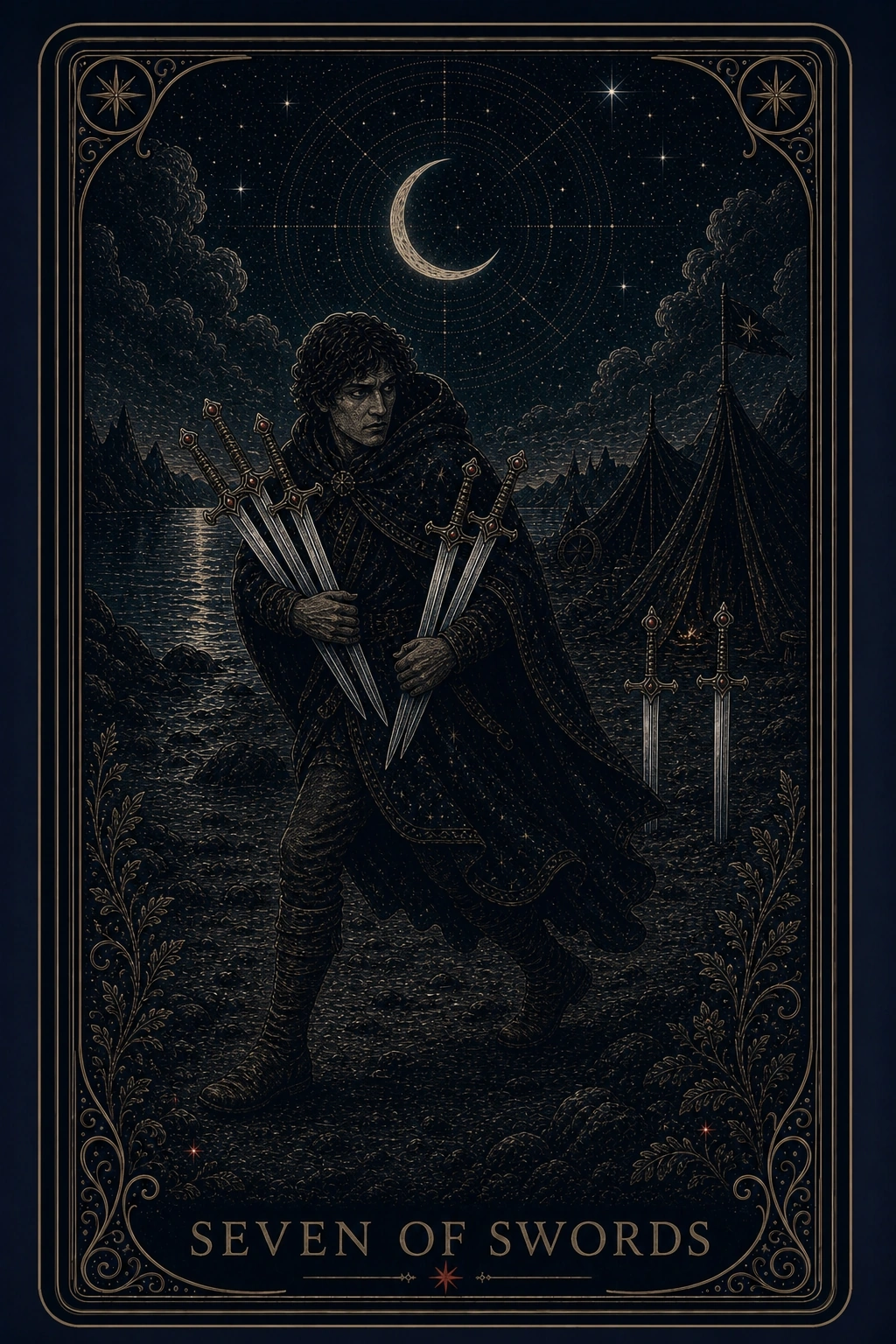
The Night Glass figure carries his five swords the only way five swords can be carried — bundled against the body, blades crowding his own face, one careless step from cutting their carrier. The deck's physics lesson: what is gathered without consent is held without a grip designed for it. Owned things get scabbards. Taken things get juggled.
His look back is the card's center — head turned hard over the shoulder toward the sleeping camp, checking. The glance that will now attend every success this maneuver produces. The deck draws the camp itself as a place of low fires and dark banners, neither innocent nor evil: whatever this camp was, the figure's exit has made it permanently unfinishable business.
And the two swords left standing — upright in the earth by the tents, red-jeweled, identical to the five in his arms. From this distance he can still see them. He will remember them larger than they were. Left things grow.
The Inverted Pattern
Running blocked, the Seven becomes the indirect life: strategy as a personality — every room worked, every truth versioned, closeness itself managed like an op — until the maintenance consumes more than the maneuvers ever gained. Or the block inverts inward: so much fear of being the seven that you announce everything, forfeiting the legitimate privacies a life requires. The inverted question: what are you currently carrying that requires a managed story — and what would happen, actually, if you set it down and turned around?
When It Finds You
The Seven of Swords tends to appear when an indirect route is being weighed — the quiet exit, the undisclosed plan, the advantage available if no one's told. It appears after the maneuver, in the glance-back phase, when the story's upkeep is coming due. And it appears around you rather than in you, sometimes: someone in the camp is gathering quietly. The card doesn't accuse. It suggests counting the swords.
The Lineage
The sword-thief slipping from the camp has been painted since the early decks — the courts that commissioned them ran on exactly this figure: the envoy, the spy, the adviser with two masters. The Renaissance perfected indirect power and knew its invoice by heart. The card is that invoice, kept legible for six centuries.
The Signal Door
What it names in you is different.
This is what Seven of Swords means in general. What it names in you is a different question.
The Signal reads one card for you — your name, where you actually are, and a pattern named with precision. It opens once per person.