Minor Arcana · Wands
Five of Wands
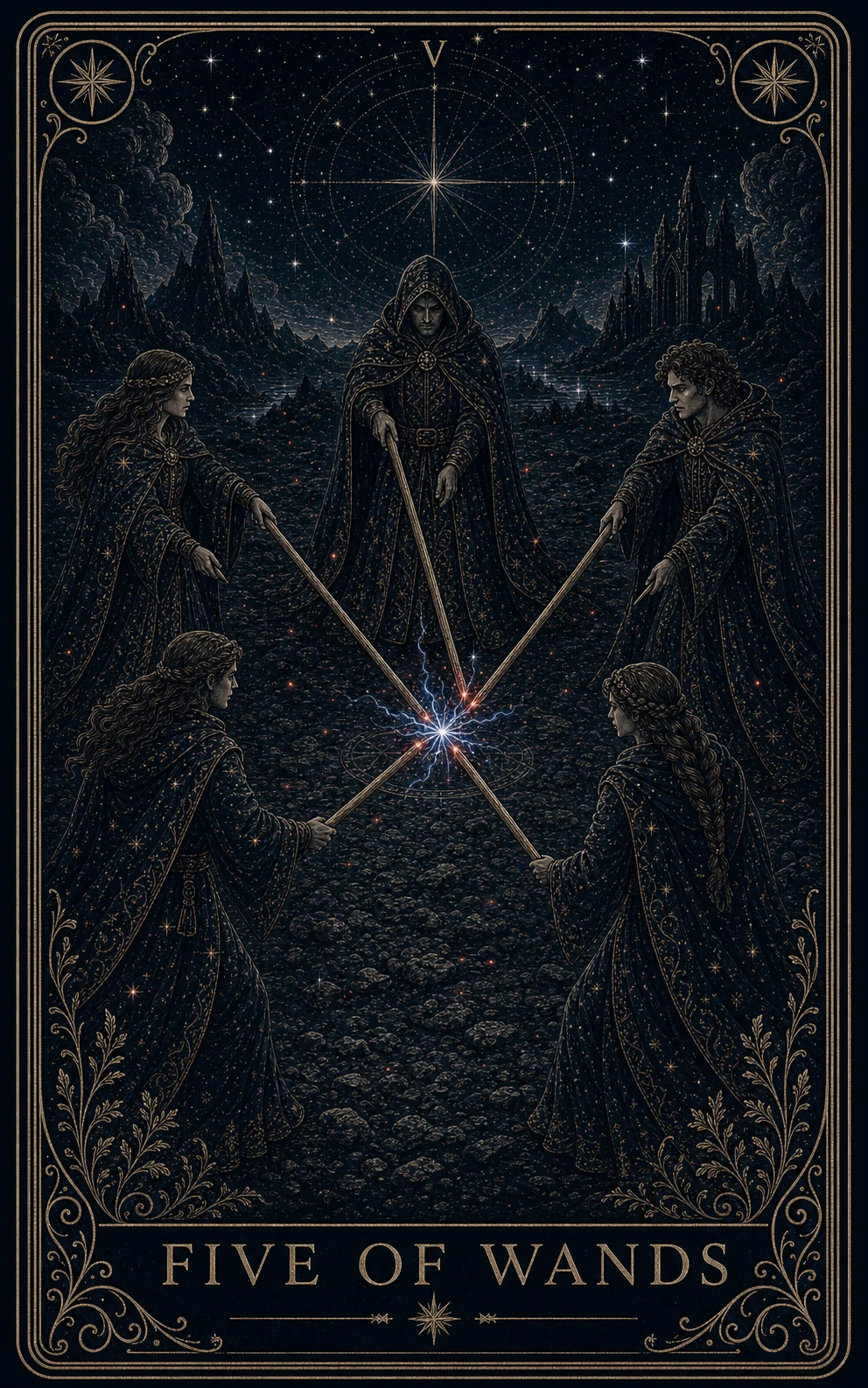
In One Line
Notice that all five staves are in the air and nobody's actually been hit. This is friction, not war.
What Five of Wands Names
The Five of Wands names the clash of live energies in a shared space — the team with five real opinions, the family with five real tempers, the inner council with five competing drives. Its first and most useful ruling is diagnostic: this is friction, not combat. Nobody on the card is wounded. The staves strike each other, not bodies.
The card understands friction as the tax on vitality. Put several genuinely lit people — or genuinely lit desires — in one enclosure and contact is not a malfunction; it is physics. The Five neither romanticizes the noise nor catastrophizes it. It asks the only question that sorts productive friction from waste: is anything being forged? Sparks that temper the ideas are work. Sparks that only repeat are heat leaving the system.
And it notes, for the conflict-avoidant, the cost of sitting out: energy that's denied the clash doesn't calm. It goes underground and clashes there.
On This Card
Five figures fill the clearing, every staff raised and crossed against another — the deck's busiest composition, deliberately so. There is no focal figure and no visible leader; the tangle itself is the subject. Sparks catch at the crossing-points, small bursts of the suit's gold where wood meets wood.
Look at the footing: nobody is retreating and nobody is down. The stances are working stances. The Night Glass reading of the scrimmage lives in that detail — this is five sources of fire discovering each other's exact weight, the necessary rough survey that happens before five flames can become one forge.
The dark around the clearing stays calm, stars undisturbed. The chaos is real and it is also local. The card frames it small against the night on purpose.
The Inverted Pattern
Running blocked, the Five becomes the ritual scrimmage: the same argument on a loop with the verbs changed, the meeting that fights about everything except the actual thing — friction maintained because it feels like engagement while protecting everyone from the one clash that would matter. The inverted question: what is the real disagreement under the recurring one — and what would it cost to have it once, cleanly?
When It Finds You
The Five of Wands tends to appear in rooms where several strong energies have new proximity — the merged team, the ambitious partnership, the family holiday. It appears when your own drives are shouting over each other and every day starts with an internal committee fight. And it appears as reassurance mid-noise: check for wounds. If there are none, this is still forging.
The Lineage
The mock battle — painted since the early decks as youths at the batons, training or brawling depending on the reader's mood that day. The ambiguity is original equipment. Six centuries have looked at this tangle and asked the same question the card asks: sport, or war? The answer has always been: watch whether anyone bleeds.
The Signal Door
What it names in you is different.
This is what Five of Wands means in general. What it names in you is a different question.
The Signal reads one card for you — your name, where you actually are, and a pattern named with precision. It opens once per person.