Minor Arcana · Cups
Four of Cups
In One Line
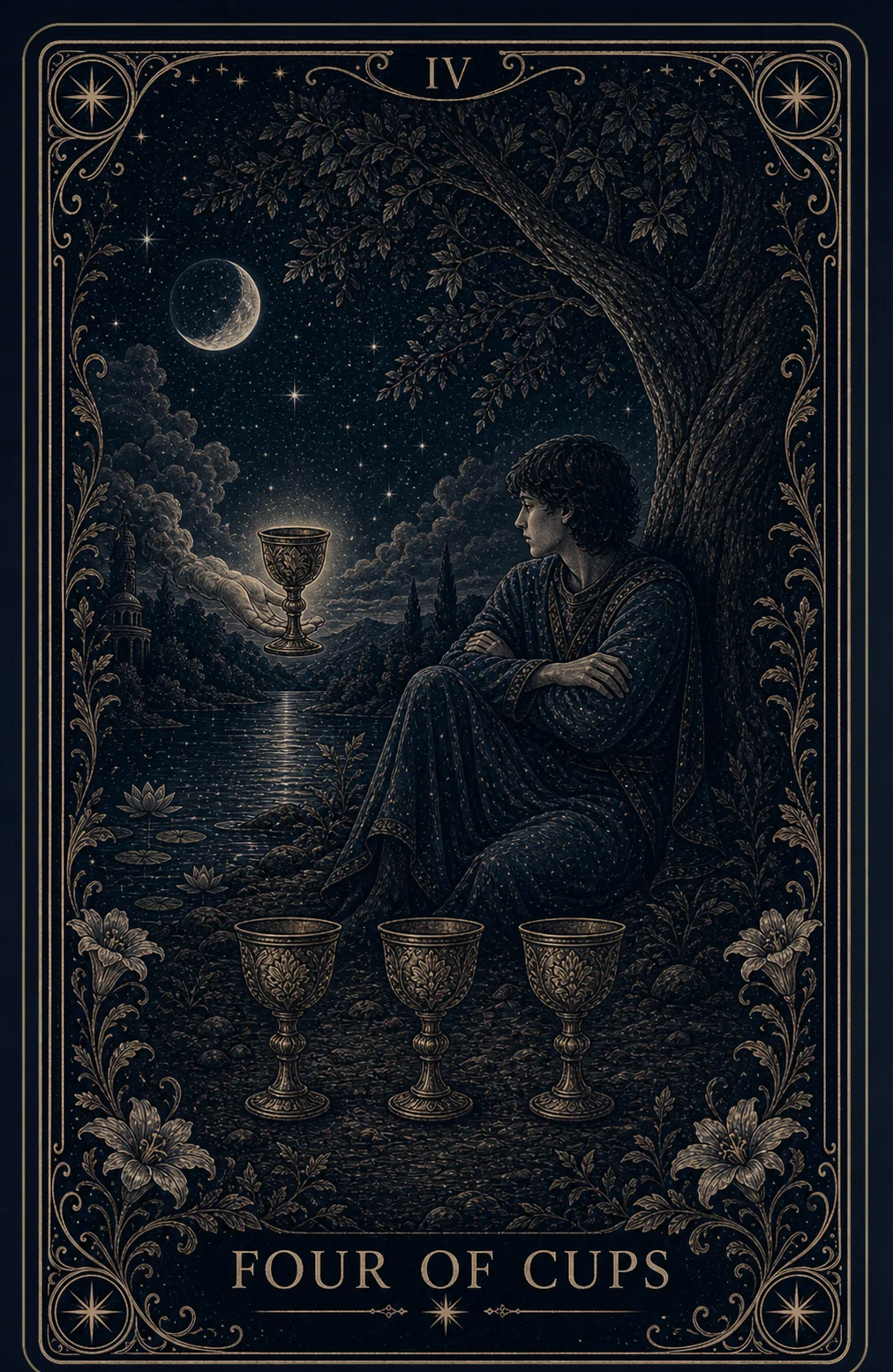
The offer is the only lit thing on the card, and you're the only one not looking at it.
What Four of Cups Names
The Four of Cups names the saturated heart — the state where feeling has gone flat not from lack but from sameness. Three full cups stand in reach and rouse nothing. The appetite isn't gone; it has stopped registering what's already held, the way a hand stops feeling the water it has been in too long.
The card's real subject is the fourth cup — the offer arriving during the numbness. It comes, as such offers do, at the exact wrong time: mid-withdrawal, mid-sulk, mid-inventory of everything that has stopped shining. And it asks the question the crossed arms are built to postpone: is this apathy, or is it protection? Because refusal-in-advance looks identical to boredom from the outside, and only one of them is about the cups.
The Four never scolds the withdrawal. Sometimes the pause under the tree is exactly right. It only insists that the pause keep one eye open.
On This Card
The Night Glass deck lights this card like an argument: the offered cup — held out over the water by a hand emerging from mist — is the single glowing object in the frame. The three cups in front of the seated figure stand dark. Same metal, same craft, no light. The deck is saying what the numb heart can't: the difference isn't in the cups. It's in whether they're still being seen.
The figure sits back against the great tree, arms folded across his knees — the body's oldest gate posture. But his face is turned toward the offer. He is looking at it. The card catches the exact hinge moment: the refusal still in the arms, the attention already gone ahead.
Behind him, the water is covered in open lotus. The saturation is real — this is a heart that has received plenty. The card doesn't dispute the fullness. It disputes what fullness is being used for.
The Inverted Pattern
Running blocked, the Four becomes refusal as identity: the crossed arms grown into a posture, every offer pre-declined because wanting something new would indict the years spent wanting nothing — disappointment converted into a philosophy and defended as taste. The inverted question: when did you decide nothing on offer could reach you — and what arrived right before that decision?
When It Finds You
The Four of Cups tends to appear in flat seasons — the good life that has stopped tasting like anything, the gratitude you can list but not feel. It appears when something new is being offered through the fog: the invitation, the person, the direction you keep almost not noticing. And it appears as a gentle x-ray of the crossed arms: check whether they're resting, or guarding.
The Lineage
The discontented youth under his tree is one of the suit's oldest figures — painted for centuries beside cups he will not look at, while a fourth arrives from a cloud. The Renaissance knew this state well enough to give it land, a tree, and full cups: even then, the painters understood that plenty and aliveness are different supplies.
The Signal Door
What it names in you is different.
This is what Four of Cups means in general. What it names in you is a different question.
The Signal reads one card for you — your name, where you actually are, and a pattern named with precision. It opens once per person.