Major Arcana
XII — The Hanged Man
In One Line
You're not stuck. You're suspended — and the view from here is the one you couldn't get standing up.
What The Hanged Man Names
The Hanged Man names the pause that is doing something. Not the stall, not the depression, not the waiting room — the suspension: the strange interval when the old approach has stopped working, the new one hasn't arrived, and the only honest position is between.
His teaching runs against every instinct of a productive life. When a thing stops working, the trained response is more force — push harder, optimize, escalate. The Hanged Man is the card of the other move: stop pulling. Hang. Let the angle change on its own schedule. He knows something about stuck problems that effort never learns — that most of them are not locked doors but perspectives, and a perspective cannot be forced. It can only be allowed to invert.
And he redeems surrender from its reputation as defeat. His is active surrender — chosen, deliberate, upside down on purpose. There is a difference, visible in the body, between a person who has given up and a person who has let go. The first is collapsing. The second is listening. This card is the listening.
On This Card
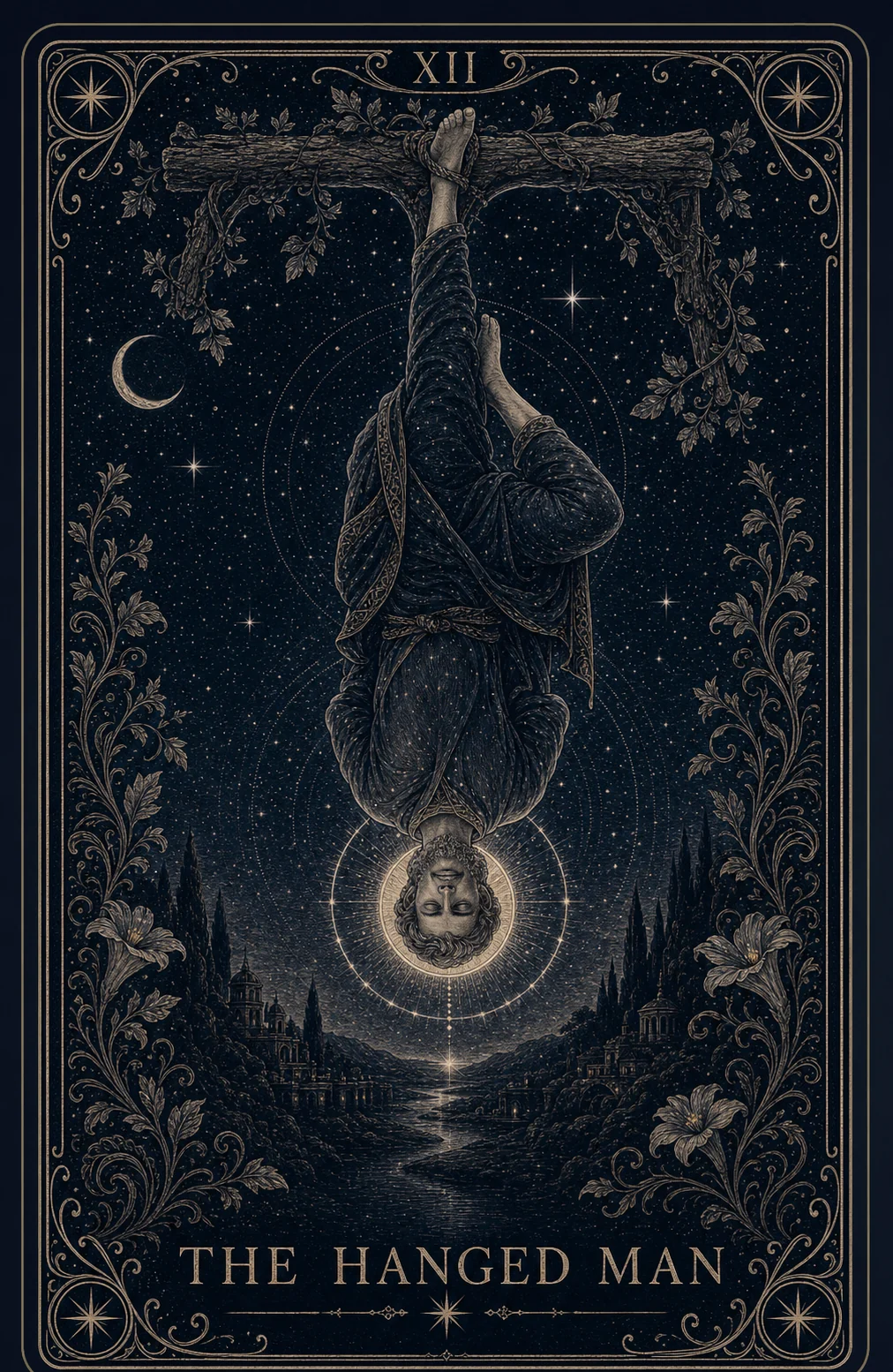
The Night Glass Hanged Man is suspended from a living branch — not a gallows, not a scaffold: a bough in full leaf, vines wrapped green around it. The deck's first correction to every fear about this card is the wood itself. What holds you in suspension is alive. This is not an execution. It is an orchard.
His halo has slipped to the bottom of the card — the light gathered around his lowered head, the brightest point in the image at its lowest position. That is the entire teaching painted plainly: in this posture, illumination pools at the bottom. The head had to go below the heart for the light to find it.
And look at what his inverted eyes now face: the river valley, the far towers, the whole landscape — the same world, upside down, and he is the only figure in the deck seeing it from this angle. His face is not straining. One leg is bent at ease. Whatever he came to understand up there, it is arriving, and he is in no hurry to interrupt it.
The Inverted Pattern
Running blocked, The Hanged Man splits two ways: the suspension refused — the same failing approach applied harder, the door shouldered long after it needed a different key — or the suspension squatted in, the pause extended past its harvest until "waiting for clarity" becomes a permanent address and the rope starts to look like furniture. The inverted question: is your stillness still producing new angles — or did the seeing finish a while ago, and the hanging continue because coming down means acting on what you saw?
When It Finds You
The Hanged Man tends to appear when force has had its full turn and failed — the problem pushed on for months that only tightened. He appears in enforced pauses that arrived without consent: the recovery, the delay, the season where life benched you, carrying the possibility that the bench has a view. And he appears just before reversals of understanding — when you are days away from seeing the whole situation upside down, and the only remaining requirement is that you stop struggling long enough to let the inversion finish.
The Lineage
The Renaissance knew exactly what it was painting: in the Italy of the first decks, traitors were hung upside down — the shame posture, public and deliberate. The deck took the era's image of disgrace and hid a halo in it, and six centuries have unpacked the smuggled meaning: what the world reads as your undoing may be the exact position the seeing requires.
The Signal Door
What it names in you is different.
This is what The Hanged Man means in general. What it names in you is a different question.
The Signal reads one card for you — your name, where you actually are, and a pattern named with precision. It opens once per person.