Minor Arcana · Pentacles
King of Pentacles
In One Line
Same coin as the clutching man in the Four — completely different hands. His are at rest around it. That difference is the entire suit, learned.
What King of Pentacles Names
The King of Pentacles names mastered abundance — the suit's whole curriculum, graduated. The offered ground of the Ace, the juggling, the craft, the grip outgrown, the winter survived, the harvest waited for, the bench years, the garden, the estate: all of it resolved into a figure for whom material life has become quiet. He is wealth with nothing to prove — the builder whose structures now build, the toucher of ventures that thrive because his touch carries thirty years of knowing what thriving requires.
The card's core is the transformed relationship to the coin. In the Four, the same gold is clutched by a man it owns. Here it rests in open, settled hands — held with the ease of someone who could set it down, and therefore doesn't have to. That is the suit's final teaching in one grip: security is not the amount. It is the looseness the amount was supposed to buy and rarely does.
And it names the throne's true work: steward, not dragon. A King of Pentacles hoarding is just the Four with better furniture. The office exists to make abundance ambient — soil, patronage, steadiness — for a realm's worth of people still climbing the suit he finished.
On This Card
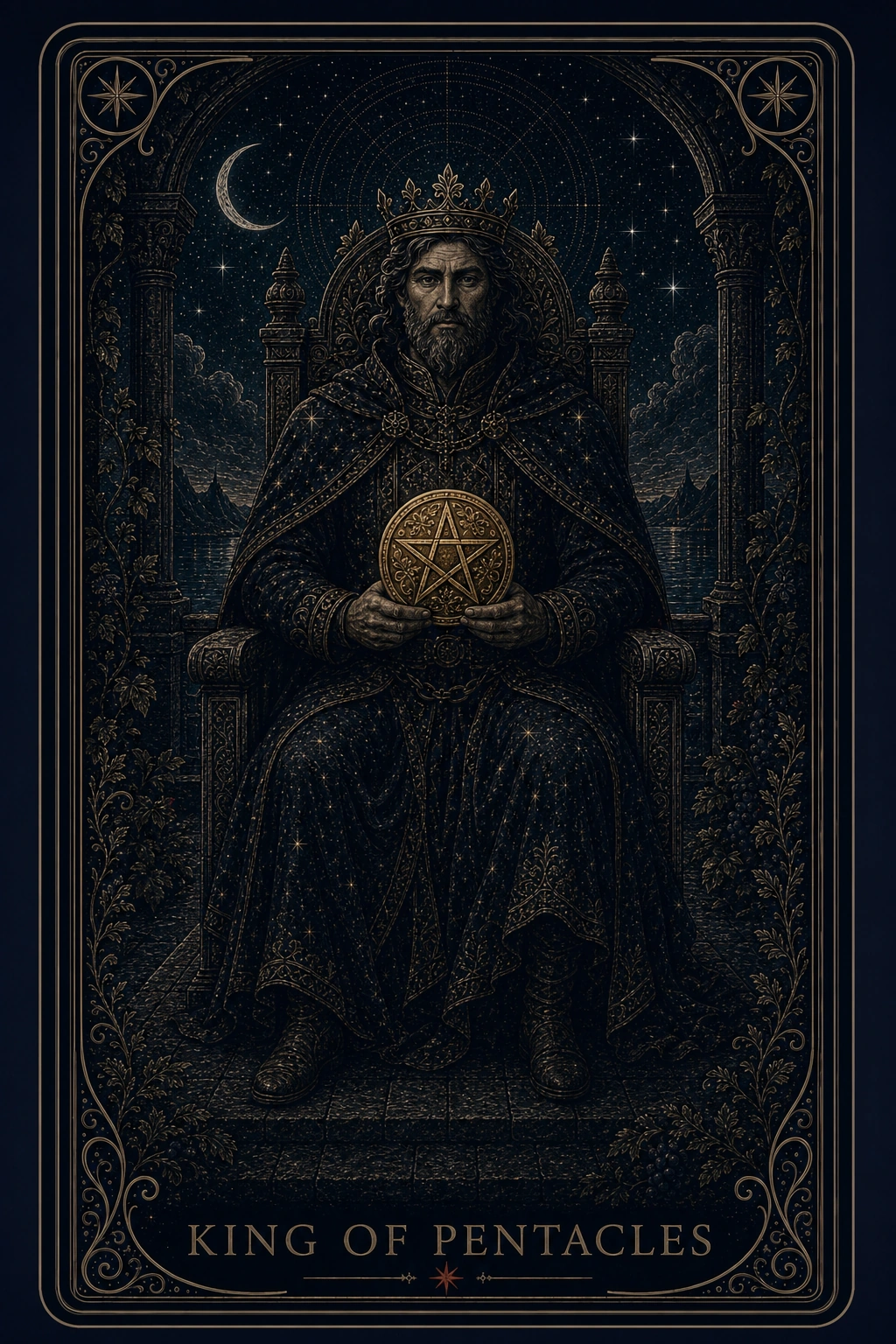
The Night Glass King holds the coin in both hands, low and level, at complete rest — and the deck built the card so you'd compare. The Four's figure clutches this exact coin to his sternum like an organ; the King's hands close around it the way they'd close around a cup that isn't going anywhere. Every year of the suit's education is legible in the difference between those two grips.
Around the throne, the grapevines hang heavy — clusters ripening in the carved margins, the harvest arriving without his attention. The deck surrounds him with yield he is not working for: the mark of mature ground, and of the long-dead labor compounding inside it. The Knight tended these rows once. The King is what the tending became.
He faces fully frontal — like the King of Swords, but the effect is inverted. That frontality is a blade's challenge; this one is a hearth's. Open posture, settled weight, pillars and open arches at his back with the water beyond: nothing guarded, because nothing here can be taken by anything that arrives suddenly. Ground, held this long, holds back.
The Inverted Pattern
Running blocked, the King becomes the empire that ate the emperor: abundance re-hardening into acquisition, the realm's steward converted to its biggest appetite — worth measured again in amount, the one metric the throne was supposed to retire. Or generosity ossifies into patronage with a throne attached: supported people, managed lives. The inverted question: if the holdings halved tonight, name what remains — and how long has it been since you were sure of the answer?
When It Finds You
The King of Pentacles tends to appear at the threshold of stewardship — when what you've built starts feeding people beyond you and the job changes from building to grounding. It appears around a person of this settled weight, whose looseness around money is the actual lesson. And it appears to the still-climbing as the suit's final postcard: the point of all fourteen cards is the grip in this one. Loose. Full. Home.
The Lineage
The king of the coins closed the suit from the first Italian decks — and the men who commissioned those decks were this card: the merchant princes, bankers to popes, whose gold built the very workshops the cards were painted in. The painters knew their patrons' lesson and set it down for six centuries of strangers: the coin is the smallest thing on the card. Look at the vines. Look at the hands.
The Signal Door
What it names in you is different.
This is what King of Pentacles means in general. What it names in you is a different question.
The Signal reads one card for you — your name, where you actually are, and a pattern named with precision. It opens once per person.