Minor Arcana · Pentacles
Four of Pentacles
In One Line
Count what the holding costs: both hands full, both feet pinned, and the crown spot taken. Nothing on him is free to do anything else.
What Four of Pentacles Names
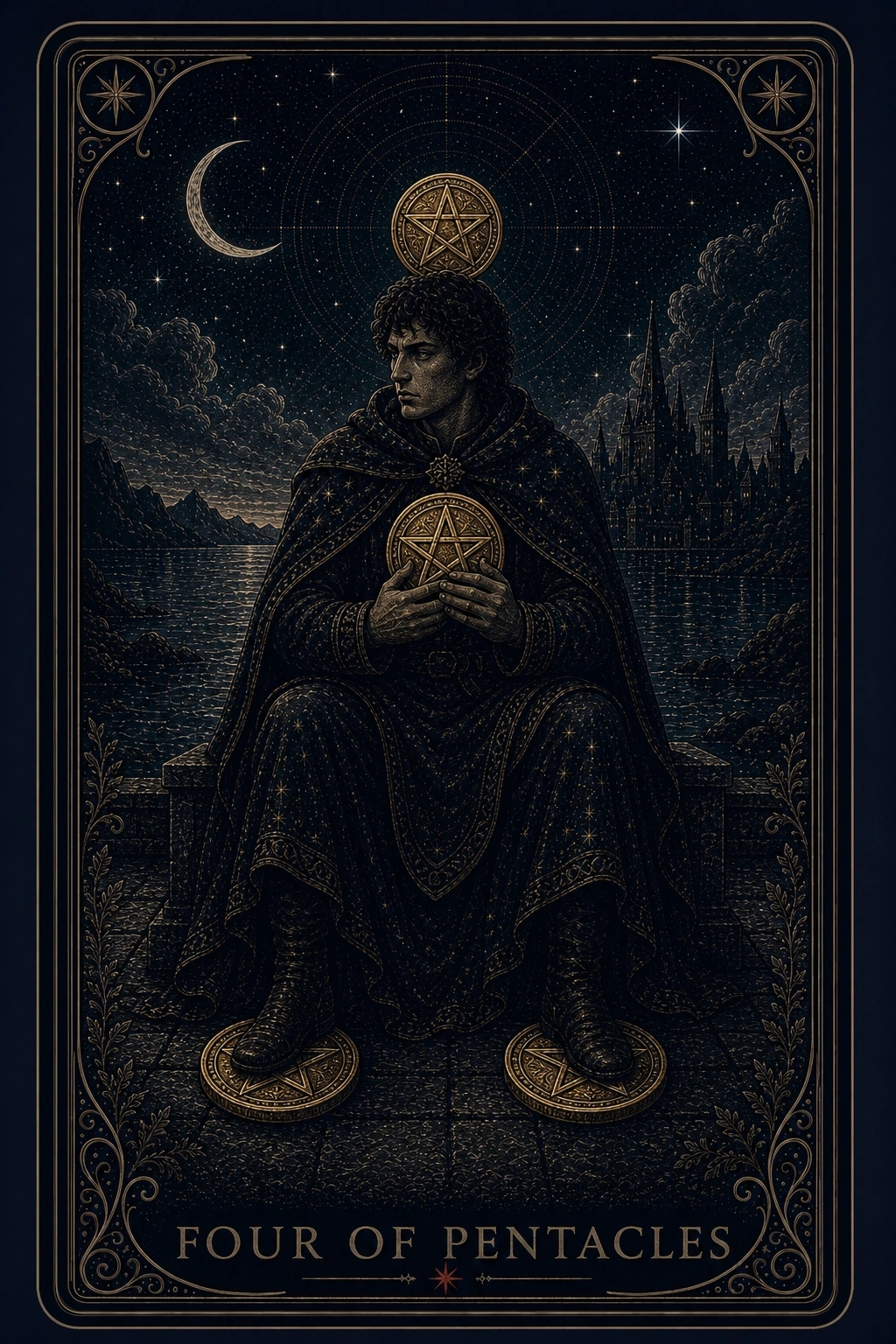
The Four of Pentacles names security become grip. Four coins, all deployed in defense: one clutched to the chest, one weighing on the head, two pinned under the feet. The card's subject is not wealth — it is the posture wealth can put a body into, and what that posture makes impossible. Hands that hold cannot build, receive, or greet. Feet that pin cannot walk. A crown of coin cannot think past the coin.
The card is fair to the grip's origin. Nobody clutches like this who wasn't once emptied. Somewhere behind every Four of Pentacles is a Five — a winter, a loss, a season that taught the hands what scarcity feels like — and the grip is that lesson, still running years after the winter ended. The card never mocks the holding. It dates it.
And it names the quiet arithmetic of enough: security is real up to a line, and past that line every additional unit of holding purchases nothing but more holding. The Four is the portrait of a man exactly on that line, facing the wrong way.
On This Card
The Night Glass figure has been fully occupied by his own coins — the deck drew the arrangement as a kind of armor that armors nothing. Chest: covered. Crown: taken. Feet: planted on gold and therefore planted, period. His eyes cut sideways, tense, guarding against an approach the card doesn't even bother to draw. The threat is unspecified because the posture no longer requires one.
Behind him — and it is entirely behind him — the city glows across the water. Towers, lit windows, the whole warm commerce of other people. He is seated with his back to the only thing on the card that could actually use what he holds, or replenish it. Wealth defended in isolation, the deck notes, is wealth already half-lost: it has stopped circulating, and this suit's coin, like its ground, lives on circulation.
He sits on cut stone — a block, not a throne. The card's driest detail. The seat this posture earns is sturdy, square, and carved for no one.
The Inverted Pattern
At full strength, the Four annexes everything: the grip extends from money to time, to information, to affection — everything held, nothing risked, the scarcity winter answered with a permanent scarcity posture, until the person becomes their own locked vault, contents unaudited for years. The inverted question: what winter is your grip still answering — what year was it, exactly — and what would one open hand, tested small, actually put at risk today?
When It Finds You
The Four of Pentacles tends to appear when holding has quietly replaced having — the savings that can't be spent on the thing they were saved for, the calendar defended against the people it was earned for. It appears after a scarcity season, as the grip's expiration notice. And it appears before a genuine opportunity that will require open hands — arriving early, so the hands have time.
The Lineage
The miser with his four coins is one of the suit's oldest portraits — painted by the same merchant cities that invented modern money and immediately began painting warnings about it. The Renaissance knew both figures personally: the banker who funded the cathedral and the one who died atop the vault. It put the second one on this card, facing away from his own city, so the first ones would remember.
The Signal Door
What it names in you is different.
This is what Four of Pentacles means in general. What it names in you is a different question.
The Signal reads one card for you — your name, where you actually are, and a pattern named with precision. It opens once per person.