Minor Arcana · Swords
Queen of Swords
In One Line
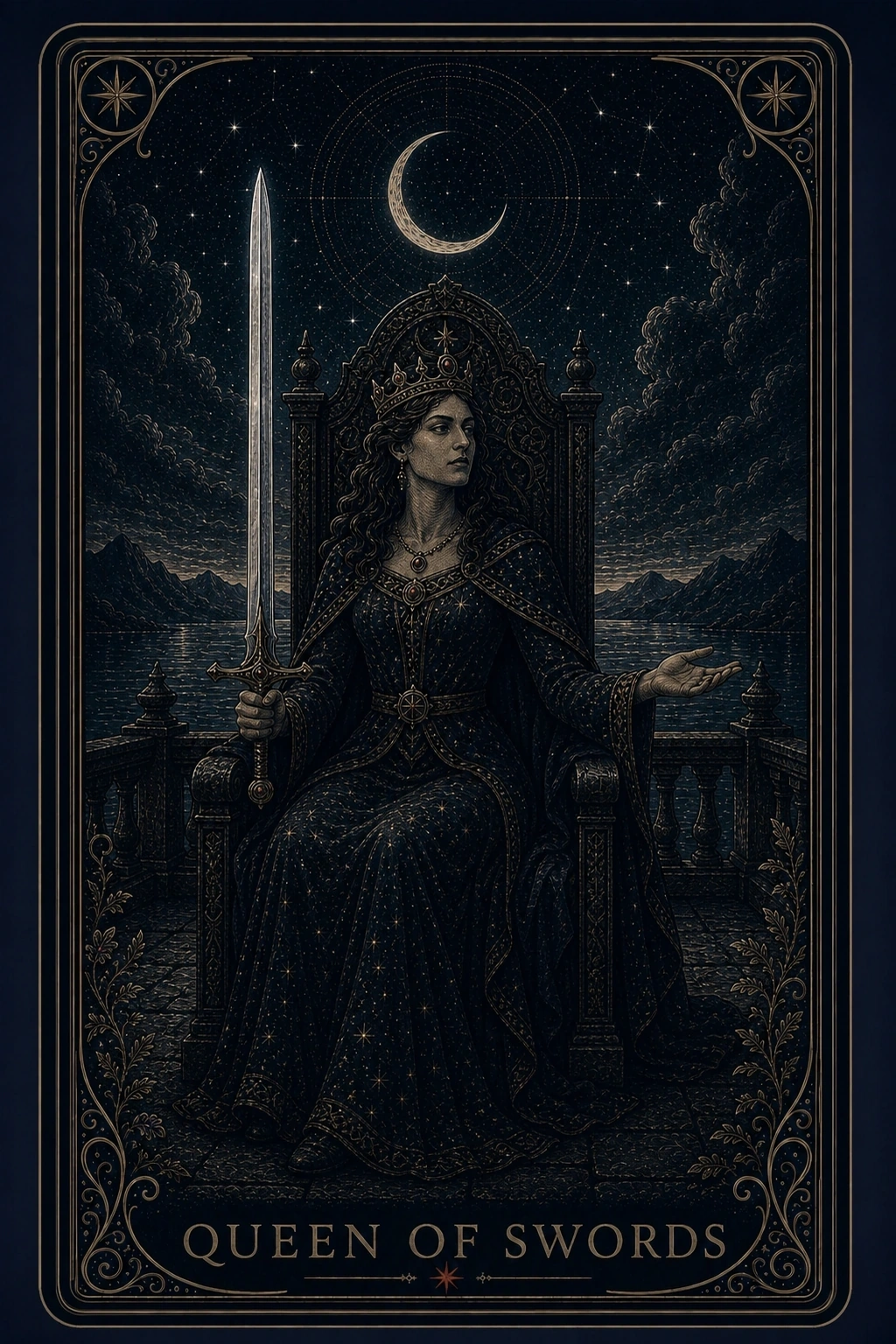
One hand holds the sword. The other is open, palm up. Bring her the truth and you get the open hand. Bring her the story and you get the edge.
What Queen of Swords Names
The Queen of Swords names clarity matured into character — the mind that has been through enough to have earned its precision. She is the one who sees through the performance and says so kindly, or says nothing and simply declines to fund it. The friend whose advice arrives unpadded and lands true. The standard-keeper: around her, people find themselves telling the cleaner version of the story, because the padded one visibly isn't working.
The card is emphatic about what her sharpness is not. It is not coldness — it is the specific warmth of someone who will not waste your time or let you waste your own. Sorrow is in her résumé; the traditional readings gave her losses, and the Night Glass keeps them: this clarity was purchased. She cuts cleanly because she knows precisely what unclean cutting costs.
And she names a mercy the gentler courts can't offer: the mercy of accuracy. There are hours when what a person drowning in story needs is not comfort but one true sentence, said once, without decoration. She is the deck's keeper of that hour.
On This Card
The Night Glass Queen rules with two hands doing two different jobs — and the card lives entirely in that split. The right holds the sword upright: judgment, present and visible, never brandished, never sheathed. The left is extended open, palm up — the deck's most generous gesture, offered by its sharpest figure. An invitation with terms. Come forward. Bring it as it is.
She sits on an open terrace — balustrade, wide water, mountains, weather visible in every direction. No walls, no veil, no enclosed chamber: this Queen conducts her court in full view of the sky, because a mind like hers has nothing it needs to keep out of the light. The clouds sit low and she sits higher.
Her gaze goes level and slightly aside — not at the viewer, at the approach. She watches the road by which everything arrives at her, which is how she is never surprised by what does.
The Inverted Pattern
Running blocked, the Queen's edge outlives its mercy: precision as preemption — everyone read before they speak, every softness audited for the lie it might contain, the open palm withdrawn until only the sword hand is offered. The clarity that losses bought becomes the wall that guards against new ones. The inverted question: when did accuracy become your armor — and who has earned the open hand that you're still showing the blade?
When It Finds You
The Queen of Swords tends to appear when the hour needs one true sentence — yours to say, or yours to receive. It appears around a person of this build, whose unpadded counsel is worth more than a year of comfortable agreement. And it appears as a two-hand audit: check what you're offering people lately. All palm and no sword helps no one. All sword and no palm keeps no one.
The Lineage
The Queen of the blades was painted from the first courts as the one who had lost — the widow-queen of the old readings, seated in weather, sword kept. Six centuries agreed on her essence: sorrow converted to sight. The open extended hand rode down the decks beside the blade, and the painters never resolved the two into one gesture. They knew she is the two gestures, held at once.
The Signal Door
What it names in you is different.
This is what Queen of Swords means in general. What it names in you is a different question.
The Signal reads one card for you — your name, where you actually are, and a pattern named with precision. It opens once per person.