Minor Arcana · Wands
Six of Wands
In One Line
Receive the recognition all the way. Deflected credit doesn't make you humble — it makes the record wrong.
What Six of Wands Names
The Six of Wands names victory at the moment it becomes public. The work succeeded and — this is the card's actual subject — other people know. The rider is not returning from the win; he is riding through the seeing of it, and the card governs that exposed passage.
What it understands is how badly recognition sits on people who wanted it. The reflexes fire instantly: deflect, minimize, redistribute — "it was a team effort," "honestly it was luck" — anything to shorten the time spent visible. The Six of Wands rules against the reflex. Received honor completes a circuit: the crowd's raised staves are their fire acknowledging yours, and refusing the acknowledgment doesn't protect the relationship. It falsifies the ledger, for them and for you.
The card is also honest about elevation's cost: the rider can be seen by everyone, which means every kind of seeing. Visibility is the prize and the price, one item.
On This Card
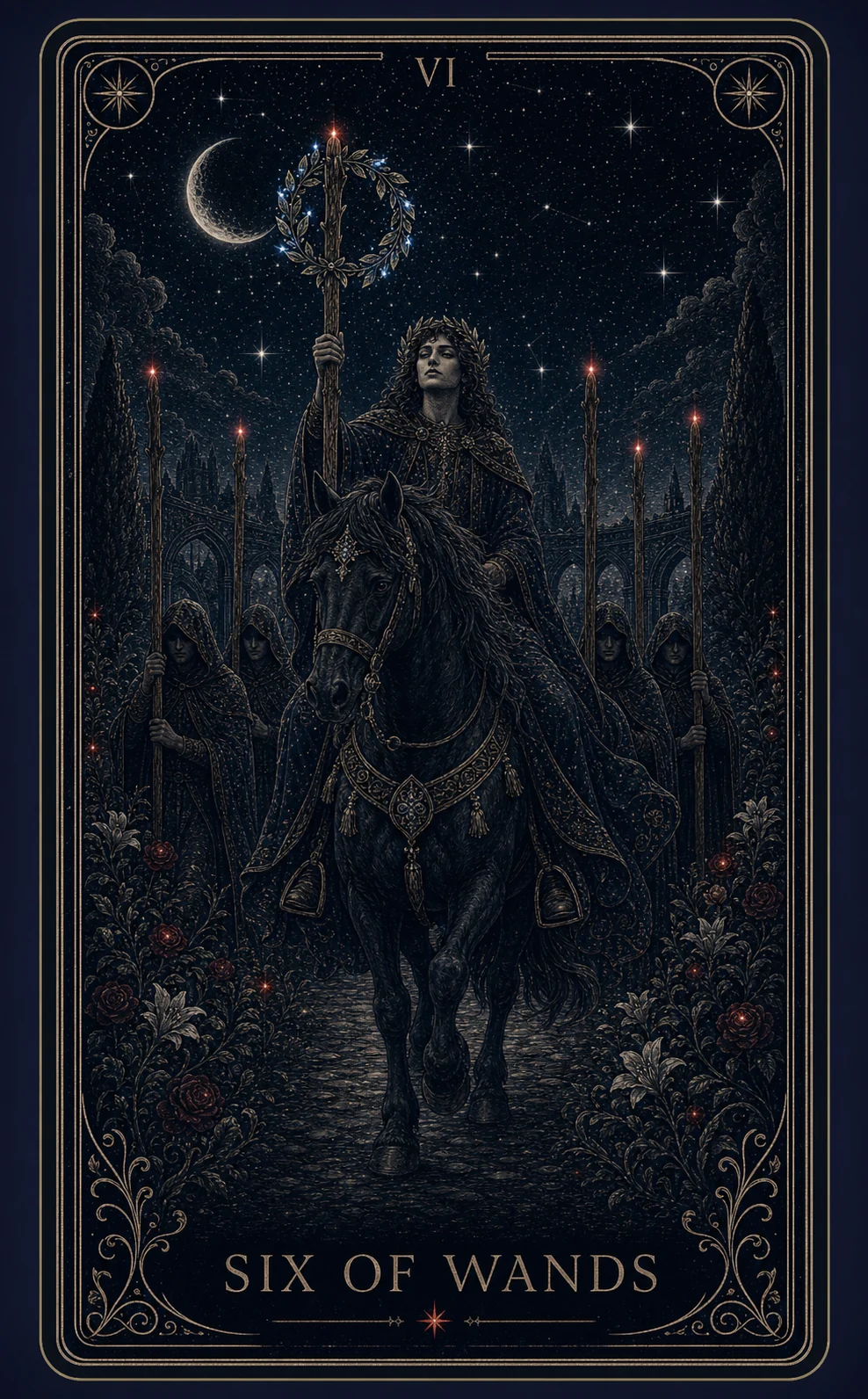
The Night Glass rider moves through the crowd, not above it — the deck keeps him at horse-height, close enough that the raised staves around him almost touch his own. The victory stays inside the community that witnessed the work; nothing on the card floats free of the people.
His staff carries the wreath, and he carries it high — not wearing it, holding it up where it can be seen. The distinction is the card's center: honor displayed as fact rather than worn as identity. The laurel on the staff can be set down later. The laurel grown into the head cannot.
The horse is pale against the dark press of figures, the one bright mass in the composition, and it walks — no gallop. Recognition, this deck says, should be moved through at walking pace: fully, and without hurrying to be done with it.
The Inverted Pattern
Running blocked, the Six splits two ways: the deflected win — praise batted away mid-sentence until the crowd learns to stop offering it — or the win that became a residence, the wreath still being mentioned years past its season. Both are the same error at different speeds: treating a moment as either nothing or everything. The inverted question: which is your reflex when seen at your best — and what did receiving fully use to cost you?
When It Finds You
The Six of Wands tends to appear just before or just after public credit — the announcement, the promotion, the work shared under your own name. It appears when you catch yourself pre-drafting the deflection. And it appears in seasons where private progress is real but unwitnessed, as a nudge: let it be seen. The circuit wants closing.
The Lineage
The laureled rider is Renaissance to the bone — the triumph, the formal procession through the city that Italian towns staged for their victors, wreath and warhorse and watching crowd. The card lifted the ceremony whole. Six hundred years later it still asks the processing figure the same thing: can you stay on the horse the entire route?
The Signal Door
What it names in you is different.
This is what Six of Wands means in general. What it names in you is a different question.
The Signal reads one card for you — your name, where you actually are, and a pattern named with precision. It opens once per person.