Major Arcana
VIII — Strength
In One Line
The part of you you've been fighting isn't your enemy. It's your power, waiting to be handled gently.
What Strength Names
Strength names the power that doesn't need to win. Not the absence of force — the graduation from it: the moment a person stops overpowering their own nature and starts working with it, and discovers the second approach is stronger by every measure that matters.
The card's real subject is the lion — which is to say, the appetite, the anger, the wanting, the wildness that most people are taught early to cage or kill. Strength makes the deck's most counterintuitive claim: the lion was never the problem. The lion is the horsepower. Every strategy of suppression — the clenched discipline, the starved desire, the rage swallowed for decades — spends enormous energy holding down the very force that could be carrying you. The hand at the lion's mouth is not restraining it. It is in relationship with it.
And it names courage's quieter form: the steadiness that doesn't announce itself, holds the room without raising its voice, and can afford gentleness precisely because it is not bluffing. Force that must be displayed is usually insecurity in armor. Strength has nothing to prove, which is how you know it's real.
On This Card
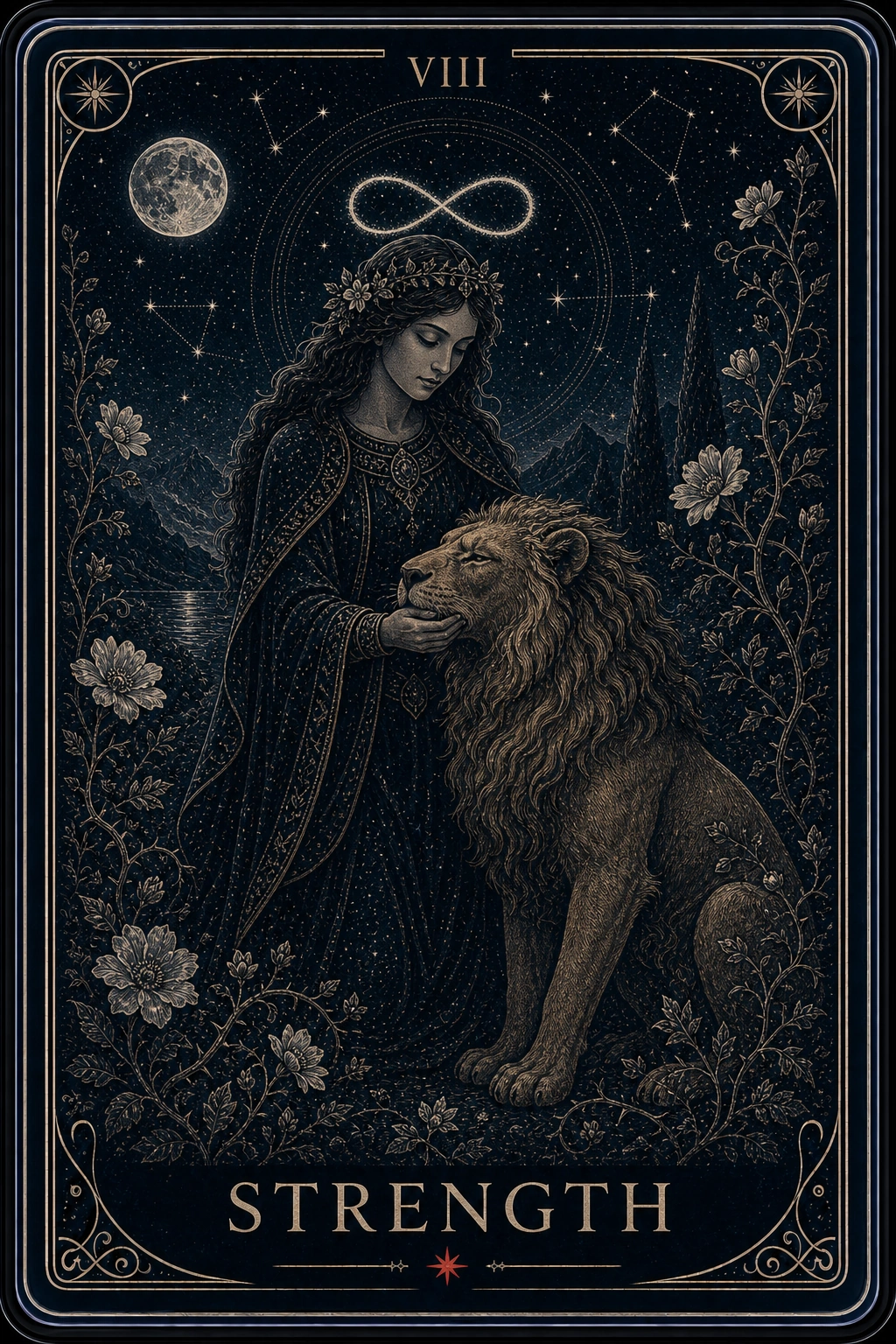
The Night Glass Strength puts one woman and one lion in a garden, and the lion is enormous — the deck did not shrink him to make the scene safe. Her hand rests at his mouth, at the teeth, the most dangerous point of contact, and her face is utterly unafraid. Not because the danger isn't real. Because the relationship is.
Look at the lion's eyes: closed, or nearly — leaning into the touch. The wildness on this card is not defeated. It is soothed, and there is a world of difference. A defeated lion is a lost engine. A soothed lion is power that stays.
Above her head the infinity loop burns — the same sign that crowns the Magician, and the rhyme is deliberate. His mastery runs through tools; hers runs through touch. Same current, older channel. And the garden around them blooms with huge pale flowers under a full moon: tenderness, the card insists, is not fragile. In this deck it grows night-hardy, at full size.
The Inverted Pattern
Running blocked, Strength splits into its two failures: the lion caged — appetite starved into depression, anger swallowed until the body keeps its books — or the lion loose, running the person who was supposed to partner it. White-knuckle control and total capitulation are the same error at different volumes: both refuse the relationship. The inverted question: what in you have you been treating as a danger to manage — and what has managing it cost you in horsepower?
When It Finds You
Strength tends to appear when the discipline is winning and the person is losing — the regimen held perfectly, the joy gone. It appears around the anger you've been swallowing so long it feels like personality, and around the wanting you've been calling too much. And it appears before rooms that will test composure: the card's counsel is never to armor up, but to walk in with the lion beside you, fed and acknowledged, on your side.
The Lineage
A figure calmly closing — or opening — a lion's mouth has stood in this position since the Renaissance decks, when fortitude was painted as one of the cardinal virtues. The centuries kept the image and gradually understood it better: the virtue was never the conquest of the beast. It was the partnership.
The Signal Door
What it names in you is different.
This is what Strength means in general. What it names in you is a different question.
The Signal reads one card for you — your name, where you actually are, and a pattern named with precision. It opens once per person.