Major Arcana
XIV — Temperance
In One Line
Balance isn't standing still. It's the living pour between two things you refuse to let collapse into one.
What Temperance Names
Temperance names the art almost nobody is taught: the exchange. Not balance as the word is usually meant — the frozen midpoint, the compromise where both sides lose evenly — but the active, continuous pour between two real things: work and rest, solitude and belonging, the fire in you and the water in you, this life and that calling.
Its first insistence is that the two things stay two. The lazy resolution of every tension is collapse — pick one, merge them, water the wine until neither tastes like anything. Temperance refuses the shortcut. The vessels remain separate vessels; what moves between them is the living stream, and the stream only exists because the difference does. A person who has murdered one side of themselves to end an inner argument has not found peace. They have found quiet, which is not the same substance.
And it names the timescale honestly: this is a practice, not an achievement. The pour is never finished — it is adjusted, daily, by feel, the way anything alive is kept alive. Which is why the card looks like an angel doing something patient. It is.
On This Card
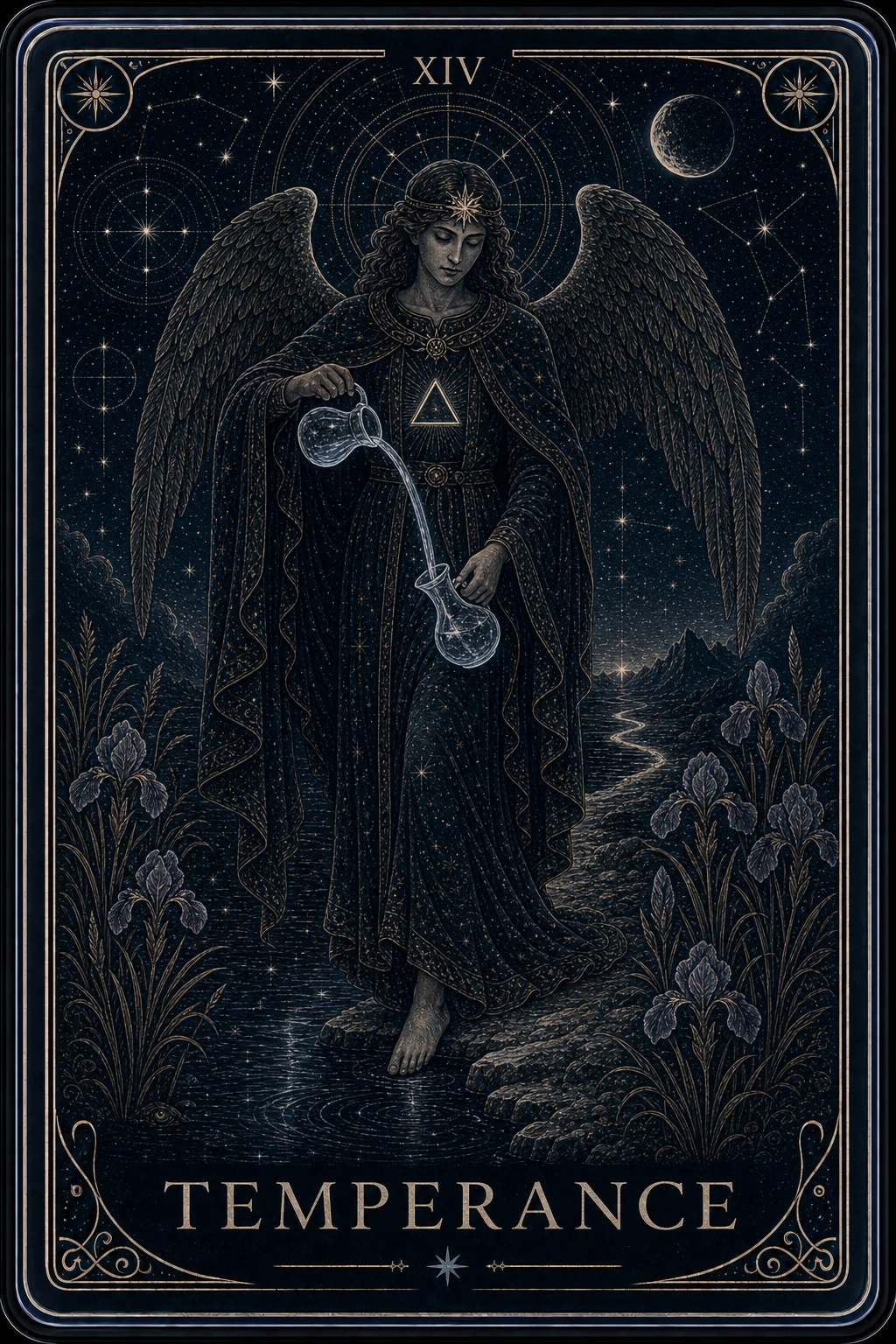
The Night Glass Temperance pours between two glass vessels — and the stream between them arcs upward against all sense, luminous, the brightest moving thing on the card. The deck painted the exchange itself as the miracle. Not the vessels. Not even the water. The transfer — the living line between two separate things — is where the light lives.
She stands at the exact edge: stone underfoot, water at her toes, the card's geography repeating its philosophy. Not on land, not in the river — at the meeting, permanently, comfortably. The place everyone else calls torn is simply her address.
On her chest, a triangle rides inside her robe's dark ground — fire's old sign carried calmly by a figure working with water. Both elements, one body, no contradiction. And behind her a path winds back through dark mountains toward a glow on the horizon: the long road this practice serves. The pour is not the destination. It is how anyone carrying two natures gets all the way home with both.
The Inverted Pattern
Running blocked, Temperance becomes the ended exchange: one vessel hoarding — all work and no restoration, all giving and no receiving, the stream dried to a trickle and then to a debt. Or it becomes the collapse it was built to prevent: the two things merged into mush, the passion managed into beige, moderation worshipped until nothing in the life has a temperature. The inverted question: name your two vessels — the real pair you carry. Which one has been doing all the pouring, and when did the return stream stop?
When It Finds You
Temperance tends to appear when a life has quietly become single-vessel — the season where one true thing ate the calendar and the other true thing went silent. It appears after extremes, as the practice that follows the pendulum: the rebuild where the lesson is proportion, not penance. And it appears around every genuine both/and — the two callings, the two loyalties, the two natures — arriving to retire the question "which one am I?" and replace it with the better one: what does the pour between them look like this week?
The Lineage
Another of the cardinal virtues the Renaissance painted into its first decks — temperantia, the mixing of water and wine, the oldest image of proportion the banquet tables of Italy knew. The centuries gave her wings and kept her vessels, understanding what the courts already suspected: of the four virtues, this unglamorous one is the one a long life actually runs on.
The Signal Door
What it names in you is different.
This is what Temperance means in general. What it names in you is a different question.
The Signal reads one card for you — your name, where you actually are, and a pattern named with precision. It opens once per person.