Major Arcana
VI — The Lovers
In One Line
It isn't about them. It's about whether you'll choose with your eyes open — desire and consequence both on the table.
What The Lovers Names
The Lovers has spent centuries being misread as the romance card, and it tolerates the misreading because the truth is close by: it is the choice card, and love happens to be where people meet their choices with the least protection.
What it names is the moment desire and consequence have to sit at the same table. Wanting something is easy. Wanting it in full view of what it costs, what it asks, what it will change — that is the card's actual subject. The Lovers does not bless or warn. It clarifies the terms, and it insists on one thing only: that the choice be made awake. A yes with open eyes and a no with open eyes are both honored here. The only thing the card refuses is the drift — the half-choice, the letting-it-happen, the yes performed while the eyes stay shut.
And underneath the choosing it names alignment: whether what you want, what you value, and what you do are facing the same direction. When they are, the choice barely feels like one. When they aren't, no partner on earth can resolve it for you.
On This Card
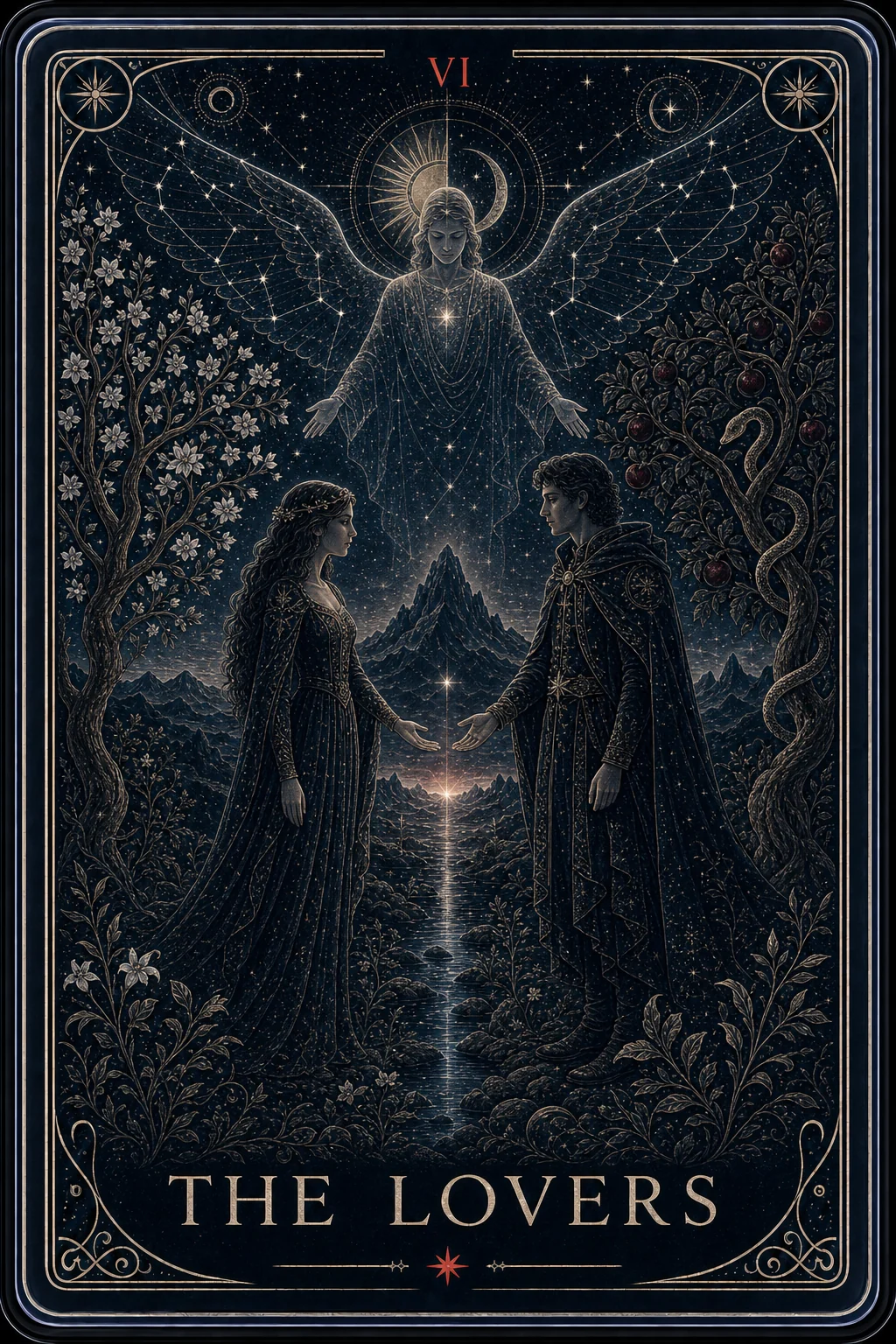
The Night Glass Lovers reach toward each other with open hands — and the hands do not touch. Between them burns a point of warm light, the brightest thing on the card. The deck is exact here: what joins two people is not contact. It is the third thing between them — the choice itself, alive, still being made.
Behind her, a tree in white blossom. Behind him, a darker tree hung with fruit, a serpent coiled through its branches. Innocence on one side, appetite and knowledge on the other — and the card places the figures between the trees, not under either one. Both inheritances are present at every real choice.
Above them, the angel's wings are made of constellations — the witness is a star map, not a judge. And from the point of light between the figures, a luminous stream runs down the mountain valley toward the viewer: the choice made here flows out of the card and into everything downstream of it. The deck paints consequence not as threat but as geography.
The Inverted Pattern
Running blocked, The Lovers becomes the outsourced choice: waiting for the other person to decide so the outcome is never your fault, keeping two options warm so neither becomes real, wanting the thing and the immunity from its costs at the same time. The drift feels safer than the decision because a drift can always be disowned. The inverted question: what choice have you been letting circumstances make for you — and how long has it actually been made?
When It Finds You
The Lovers tends to appear at genuine forks — the two paths that cannot both be walked, where waiting has quietly become its own decision. It appears inside commitments up for honest renewal: not "should this end" but "can this be chosen again, awake, knowing everything I now know." And it appears when what you want and what you say you value have started facing different directions, and the split is costing more energy than either path would.
The Lineage
In the earliest Renaissance decks the scene was plainer and blunter — a figure standing between two loves while a winged archer took aim. The card has always been a crossroads wearing romance as its costume. Six centuries have refined the image and never changed the question: now that you see both trees, which do you choose?
The Signal Door
What it names in you is different.
This is what The Lovers means in general. What it names in you is a different question.
The Signal reads one card for you — your name, where you actually are, and a pattern named with precision. It opens once per person.