Major Arcana
V — The Hierophant
In One Line
You were handed the rules before you could ask who wrote them. Asking is now allowed.
What The Hierophant Names
The Hierophant names everything you were taught before you could consent to learning it. The religion, the work ethic, the family's definition of success, the unwritten laws about what gets spoken and what gets swallowed — the whole inherited operating system, installed early, running quietly, rarely audited.
The card is neither the rebel's enemy nor the traditionalist's trophy, and that refusal to pick a side is its intelligence. Some of what was handed down is load-bearing wisdom, tested across generations, and discarding it to feel modern is its own foolishness. Some of it is fear wearing the costume of virtue, rules written for a world that no longer exists, kept out of loyalty to people who would not recognize your life. The Hierophant's work is the audit: not burn it down, not swallow it whole — open the inheritance and read it, line by line, as an adult.
What survives the reading becomes genuinely yours — inner law rather than inherited law, kept because it is true rather than because it was first. That is the door the card holds open. Tradition, it insists, was always meant to be a door.
On This Card
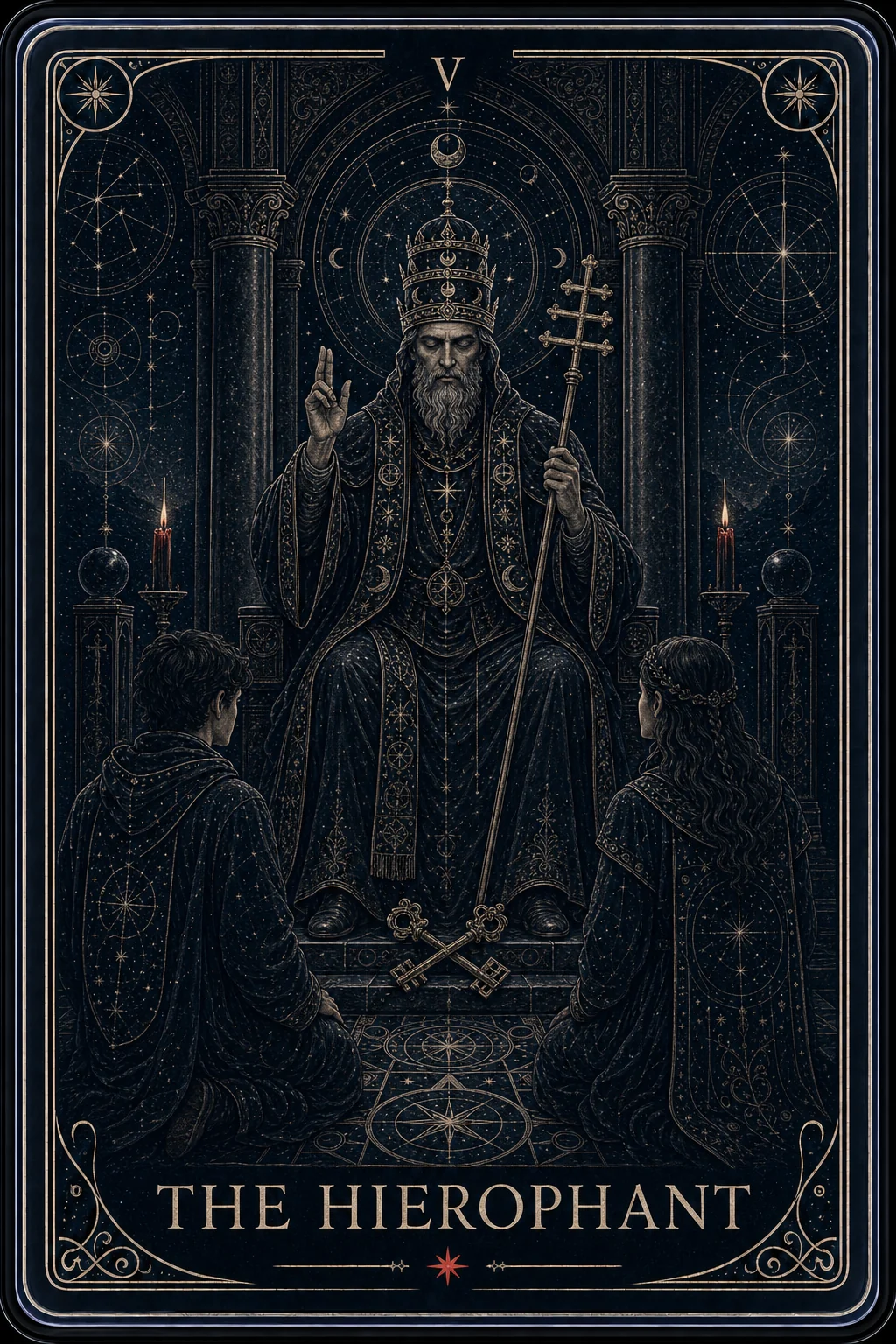
The Night Glass Hierophant raises one hand in the old blessing — two fingers up, two folded: half of what I know is spoken, half is not. The deck keeps the ancient gesture and lets it confess what every institution knows about itself.
Before the throne kneel two seekers, and the deck shows them from behind — you see what they see, the whole apparatus of authority from the supplicant's side: the triple crown, the triple-cross staff, the candles burning their small red flames. The card places you in the kneeling position on purpose. You have been here. Everyone has.
And on the floor between the seekers and the throne: two golden keys, crossed — the brightest objects on the card, and the most quietly radical detail in the deck's treatment of authority. The keys are not in the Hierophant's hands. They are on the ground, within reach of anyone who stops looking up long enough to look down. What the institution guards, the card leaves lying at your knees.
The Inverted Pattern
Running blocked, The Hierophant becomes one of two prisons: the unexamined life inside the rules — obedience so old it feels like preference, the ladder climbed to its top before checking whose wall it leans on — or the unexamined life against them, rebellion as automatic as the compliance it replaced, every tradition rejected with the same blindness that once accepted everything. Both are the audit refused. The inverted question: which of your rules have you actually read as an adult — and which are you still keeping because a child promised someone you would?
When It Finds You
The Hierophant tends to appear at the moments inheritance comes due — the career that was chosen for you performing well and feeling like someone else's, the faith of your childhood asking to be either reclaimed or released, honestly. He appears around teachers: the finding of a true one, or the outgrowing of one. And he appears when your own voice has started saying things you were taught, verbatim, and some part of you finally hears the quotation marks.
The Lineage
The Renaissance decks painted him as the pope himself — the highest inherited authority their world knew — and put him fifth in the sequence, right before the card of choice. The ordering was the teaching: first you receive the law, then you choose. Six centuries later the crowns have changed and the sequence still runs the same direction.
The Signal Door
What it names in you is different.
This is what The Hierophant means in general. What it names in you is a different question.
The Signal reads one card for you — your name, where you actually are, and a pattern named with precision. It opens once per person.