Major Arcana
XVI — The Tower
In One Line
Something you built to feel safe is breaking because it was built on a premise that was never true.
What The Tower Names
The Tower is the most feared card in the deck, and the most honest. It names the moment a structure fails — a plan, a role, a relationship, a version of yourself — and it names why: the structure was holding its shape around something false. The lightning doesn't strike at random. It strikes where the premise was weakest.
What makes The Tower bearable is what it reveals. The collapse is not the loss of something true; it is the end of the energy spent keeping something untrue standing. People who have lived through a Tower season almost always say the same thing afterward: some part of them knew. The card arrives when the knowing and the structure can no longer coexist.
The Tower clears ground. What gets built next stands on what is actually there — and that is the difference between this card and simple disaster. Disaster takes. The Tower takes what was already borrowed.
On This Card
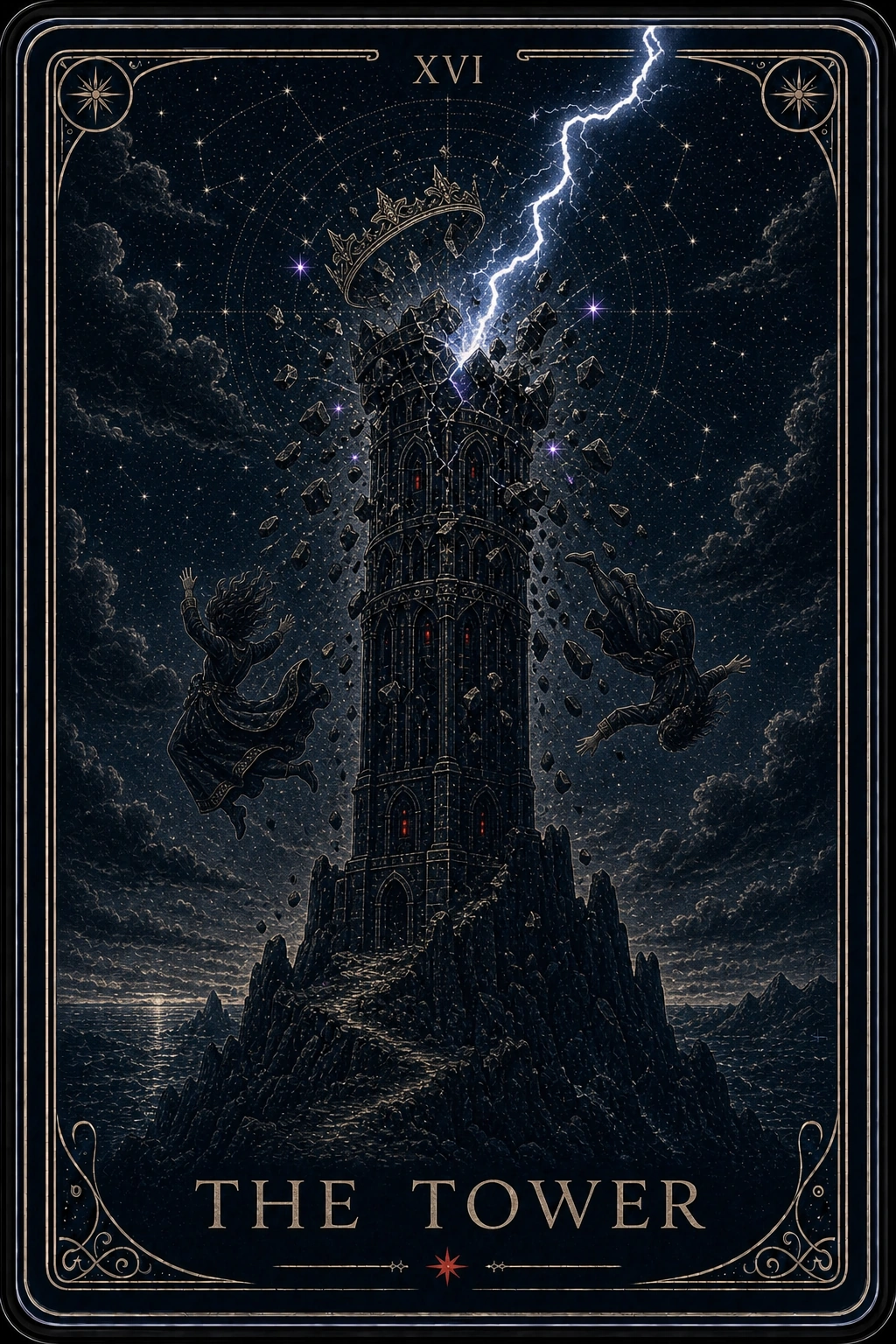
The Night Glass Tower is built of black glass — a structure you could see through the whole time, if looking had been allowed. The lightning enters at the crown, where a golden circlet is falling: the first thing to go is authority, the story about who was in charge.
Two figures fall through the night. Not one — two. A false structure is almost never held up alone; someone else was invested in it standing, and the collapse is shared even when the premise wasn't.
Look closely at the windows: small points of crimson still burn inside the breaking tower. Something alive was in there the whole time. It survives the fall. And the violet sparks scattering from the strike are the same light the deck uses wherever truth makes contact — the strike and the seeing are the same event.
The Inverted Pattern
Running blocked, The Tower is the collapse postponed: propping up what has already failed, renovating a structure whose foundation is the problem, mistaking delay for stability. The cost of holding it up quietly exceeds the cost of letting it fall — and the fall comes anyway, later, with interest. The inverted question is not "how do I keep this standing?" but "what am I paying, daily, to keep this standing?"
When It Finds You
The Tower tends to appear when a role you've outgrown is still collecting your energy — the job that was over a year before you left it. When a relationship's unspoken agreement stops being honored by one side. When the version of yourself built for other people's comfort meets a situation it cannot survive. If the card found you on a calm day, it is usually early: the lightning hasn't struck yet, but the premise is already visible.
The Lineage
The Tower has been breaking since the first decks were painted in Renaissance Italy — a lightning-struck fortress, its crown falling, painted for courts that knew exactly how quickly built power could fail. Six centuries later the image needs no translation. Every era has its towers.
The Signal Door
What it names in you is different.
This is what The Tower means in general. What it names in you is a different question.
The Signal reads one card for you — your name, where you actually are, and a pattern named with precision. It opens once per person.