Minor Arcana · Pentacles
Two of Pentacles
In One Line
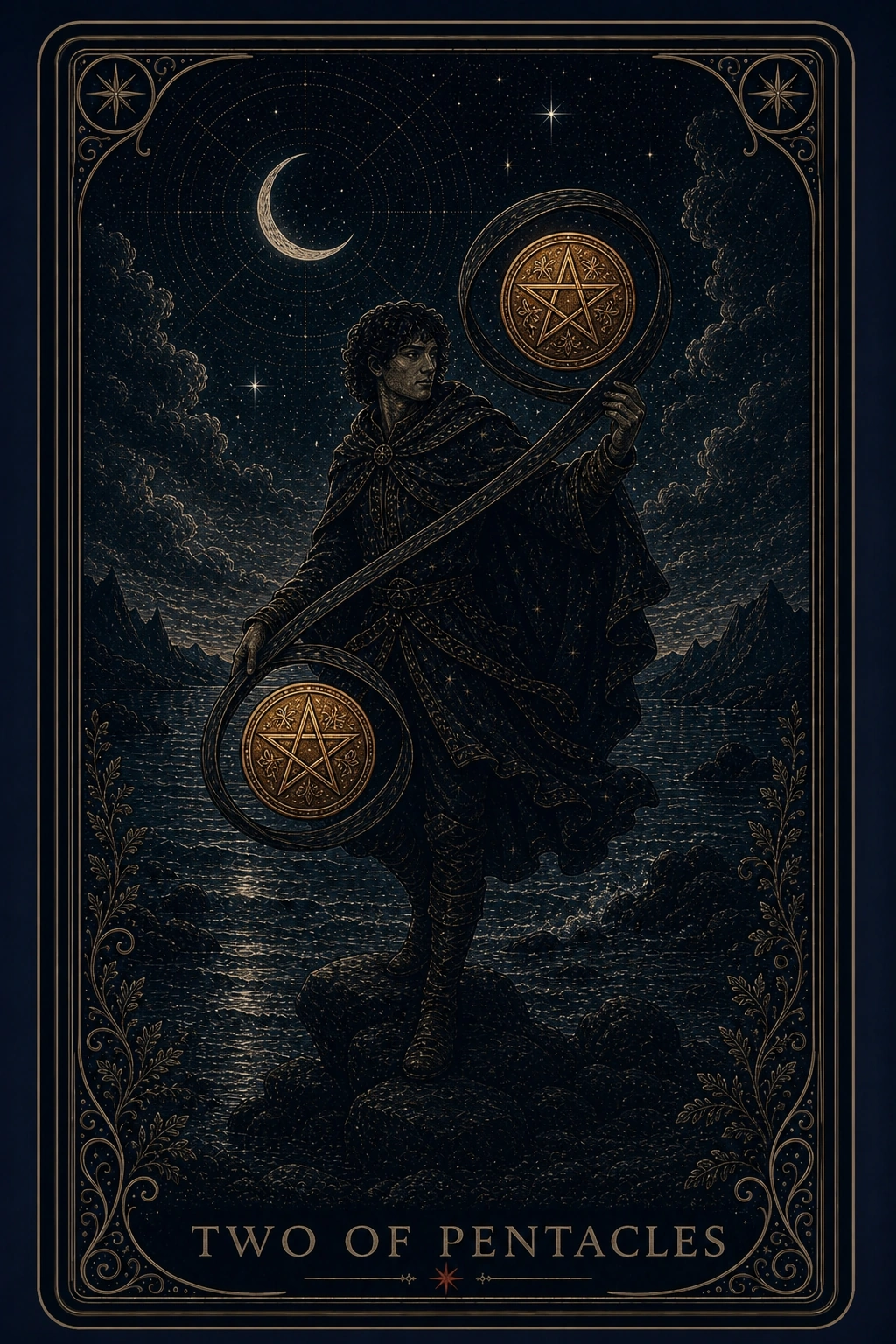
Look at his feet: solid rock. The juggling is survivable because the standing point isn't part of what's moving.
What Two of Pentacles Names
The Two of Pentacles names the working balance — two real demands, one set of hands, and the ongoing choreography of keeping both alive. The job and the family. The business and the body. This month's bills and next year's plan. The card does not resolve the tension and never promises to. It teaches the difference between balancing and being torn.
Its central insight is that sustainable juggling is rhythmic, not static. The two coins are never held still and level — one is always up while the other is down, and the health of the whole arrangement is the willingness to let them alternate. The person trying to keep both weights permanently elevated isn't balancing. They're petitioning gravity, and gravity doesn't negotiate.
And it names the true prerequisite, which is never in the hands: footing. Two moving priorities are manageable from one fixed point — a non-negotiable sleep, a marriage that isn't in play, a practice that doesn't move. Lose the fixed point, and the same two coins become the storm behind them.
On This Card
The Night Glass figure stands on bare rock at the edge of moving water — and the deck drew his feet with more care than his hands. Planted, weighted, still. Behind him the sea runs rough, waves breaking against the stones; in his hands, the two coins ride their loop. The card's whole architecture: motion above, motion behind, stillness at the one point that decides everything.
The band connecting the coins is a single continuous loop — the old infinity curve, drawn here as a strap that holds both weights in one system. The deck's point is practical: the two demands are not actually separate. Feed one correctly and the loop carries force to the other. Drop one and the loop delivers that, too.
His eyes are on the high coin — attention riding the weight that's currently up. That is the skill in one glance: not watching both at once, which is impossible, but watching the one in the air, always, while trusting the low one to the loop.
The Inverted Pattern
Running blocked, the Two becomes the frozen juggle: both coins clutched still at equal height, the alternation refused because letting either one dip feels like failing it — a life spent mid-catch, no weight ever fully held or fully released. Or the footing goes: the fixed point gets traded for one more moving commitment, and the rock joins the sea. The inverted question: what is your non-moving point right now — name it — and when did you last check it was actually still fixed?
When It Finds You
The Two of Pentacles tends to appear in the both seasons — both jobs, both roles, both true at once. It appears when the alternation is overdue: one coin has been up so long the other is going dark. And it appears as engineering advice disguised as a card: before adjusting either weight, inspect the rock. Most juggling failures are footing failures.
The Lineage
The dancer with two coins in a band has kept his balance since the early decks — painted by port cities whose whole economy was this figure: cargo on water, ships in weather, fortune in two hands at once. The painters put the sea behind him on purpose and the rock beneath him on purpose. They ran the merchant houses. They knew which one was negotiable.
The Signal Door
What it names in you is different.
This is what Two of Pentacles means in general. What it names in you is a different question.
The Signal reads one card for you — your name, where you actually are, and a pattern named with precision. It opens once per person.