Minor Arcana · Wands
Two of Wands
In One Line
The world in your hands is still the small version. Deciding is what trades it for the real one.
What Two of Wands Names
The Two of Wands names the view from the walls — the moment after the spark has been secured and before it has been spent. Something has already been built or won; that is what the parapet is. And from that safe elevation, the whole larger possibility is visible, scaled down to something that fits in one hand.
The card's subject is the specific comfort of this position. Planning from a fortification is pleasurable. The globe version of the future cooperates: it turns when turned, shows any angle on request, risks nothing. The Two of Wands is honest that this stage is necessary — vision precedes venture — and equally honest that it has a habit of becoming a residence. Walls that were won by boldness get held by caution.
Underneath, the card is about the trade every expansion demands: the actual world for the model of it, the secured position for the open one. The hand that holds the globe cannot hold anything else.
On This Card
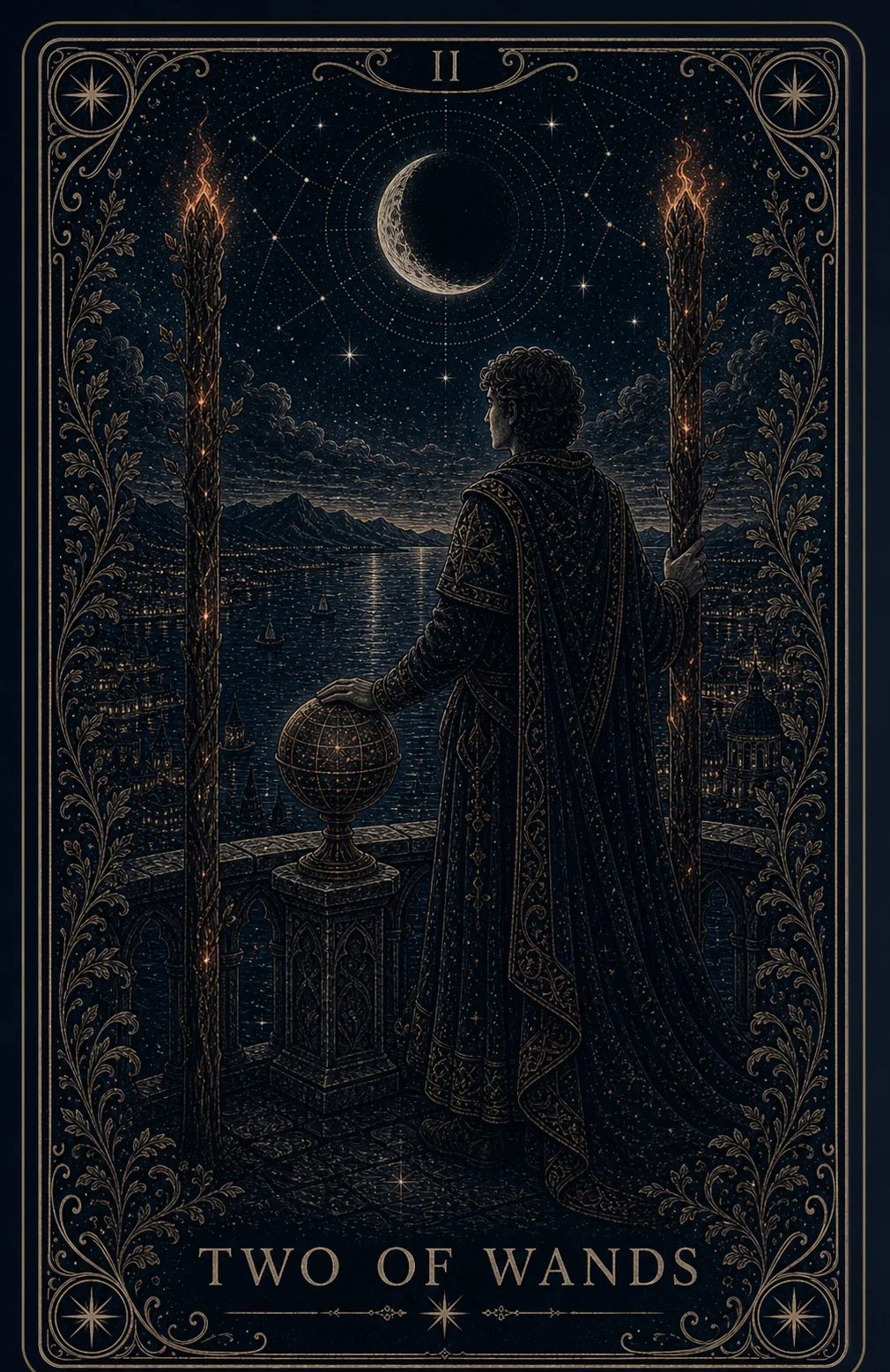
The Night Glass figure stands on high stonework with the dark landscape laid out far below — distance is the card's main material. Everything real is small from up here, which is exactly the danger and exactly the appeal.
In one hand, a globe the size of fruit, lit faintly from within: the future in its handheld edition, the only glowing thing the figure is touching. One staff stands in his grip; the second is fixed to the wall behind him — planted, finished, already past. The card counts them honestly: one wand is history, one is still a decision.
The figure's back is to the viewer and his face is to the horizon. The deck grants him the full dignity of the view. It just quietly notes, through the star field over the open dark, that everything he is looking at is still out there, none of it in the room with him.
The Inverted Pattern
Running blocked, the Two becomes the permanent overlook: strategy as a lifestyle, the five-year plan on its fifth revision, the globe polished nightly while the territory goes unvisited. Safety earned by an old boldness gets spent protecting against a new one. The inverted question: how long have you been standing at this railing — and what would you have to put down to leave it?
When It Finds You
The Two of Wands tends to appear after a first success, when the question shifts from "can I build it" to "do I leave what I built." It appears in seasons of high-quality planning that somehow never produces a departure date. And it appears when the small version of a dream — the side project, the local edition — has begun to feel suspiciously final.
The Lineage
The lord of the walls, painted since the Renaissance as the merchant prince looking out from what he already owns toward what he doesn't yet. The globe enters the image early and stays — centuries of readers have watched him weigh the same handheld world, and the card has never once shown him having decided.
The Signal Door
What it names in you is different.
This is what Two of Wands means in general. What it names in you is a different question.
The Signal reads one card for you — your name, where you actually are, and a pattern named with precision. It opens once per person.