Major Arcana
X — Wheel of Fortune
In One Line
It isn't happening to you again. It's turning again — and this time you can see the wheel.
What Wheel of Fortune Names
The Wheel names the pattern's schedule. Every life has recurring weather — the season when the same kind of person arrives, the same kind of opportunity opens, the same old collapse threatens. Most people experience these returns as fate or as personal failure: it's happening to me again. The Wheel corrects the grammar. Nothing is happening to you. Something is turning, and it has a shape, and shapes can be learned.
That is the card's actual gift — not the promise that the wheel will stop (it won't; that is the one thing it never does) but the possibility of position. There is the rim, where every turn is a whiplash, and there is the hub, where the same wheel spins and the center barely moves. The distance between those two experiences of the exact same life is what all pattern-work buys.
And it names timing as real information. Some seasons are for planting, some for pulling in the harvest, some for enduring the downswing without mistaking it for a verdict. The person who knows where the wheel is doesn't stop the turning. They stop being surprised by it — and surprise, it turns out, was most of the suffering.
On This Card
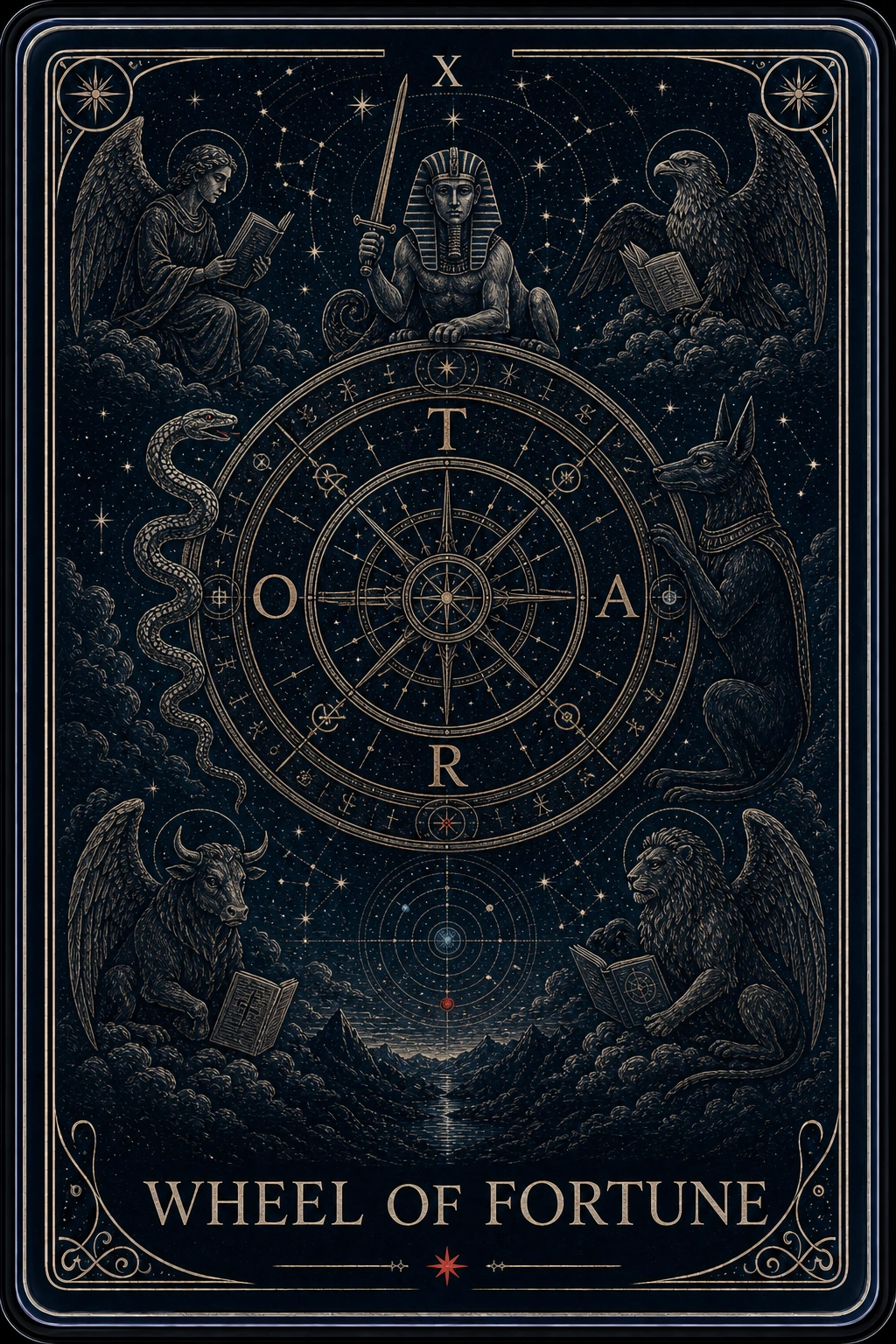
The Night Glass wheel is cut from black glass with a star burning at the hub — the still point rendered literally as the brightest thing on the card. Everything turns; the light at the center is what does not.
Around the rim, four letters ride the wheel — read them one way around the circle and they spell TARO, the other way ROTA, the old Latin word for wheel. The deck's quietest joke and truest claim in four letters: the cards and the turning are one word. Reading the one is learning the other.
On the left, a serpent descends; on the right, a jackal-headed guardian rises — something is always going down while something comes up, and neither state is permanent enough to build an identity on. And in the four corners, four winged figures — angel, eagle, bull, lion — each absorbed in an open book. They do not ride the wheel. They study it. The card offers you their seat: the pattern can be read from outside the spin, and the readers are the calmest figures in the image.
The Inverted Pattern
Running blocked, The Wheel becomes the unread pattern: the same season arriving for the fifth time and being greeted, again, as a stranger — the same argument, the same hire, the same January collapse, each round narrated as bad luck. Or it becomes fatalism's armchair: since the wheel turns anyway, why steer — luck promoted to a philosophy so effort can be excused. The inverted question: what has happened to you at least three times — and what would change if you stopped calling it coincidence and started calling it a schedule?
When It Finds You
The Wheel tends to appear when a familiar season is starting and hasn't announced itself yet — the early weather of a pattern you know, arriving before you've consciously noticed. It appears at genuine turns of luck, in both directions, counseling the same thing for each: hold the hub, this too is a position on a circle. And it appears when you've been taking a downswing personally — the card gently reclassifying what felt like a verdict as, simply, a season.
The Lineage
The wheel of fortune was medieval Europe's favorite picture of earthly life — kings riding up one side and falling down the other — and the Renaissance decks inherited it whole. Six centuries have only sharpened its point: the turning was never the news. The news is where you learn to sit.
The Signal Door
What it names in you is different.
This is what Wheel of Fortune means in general. What it names in you is a different question.
The Signal reads one card for you — your name, where you actually are, and a pattern named with precision. It opens once per person.