Minor Arcana · Swords
Eight of Swords
In One Line
Eight swords, and not one of them in front of you. The corridor was open the whole time.
What Eight of Swords Names
The Eight of Swords names the thought-built prison — the confinement constructed entirely from conclusions. "I can't leave." "It's too late." "People like me don't." Eight of them, planted like a fence, each one a sentence that was believed on arrival and never re-inspected. The card's subject is not captivity. It is the architecture of captivity, and who the architect was.
What it maps with terrible precision is the mechanism: bindings that hold only while unexamined. The blindfold that is actually the load-bearing element — because the restraints on this card cannot survive being looked at, the system's one absolute requirement is that no one looks. Every "I can't," tugged firmly once, turns out to be tied to nothing.
And the card is compassionate about why the looking gets refused: if the bindings are real, the stuckness is fate. If they're loose, the stuckness was a choice — and every day of it becomes a day that could have gone differently. The blindfold protects against the math.
On This Card
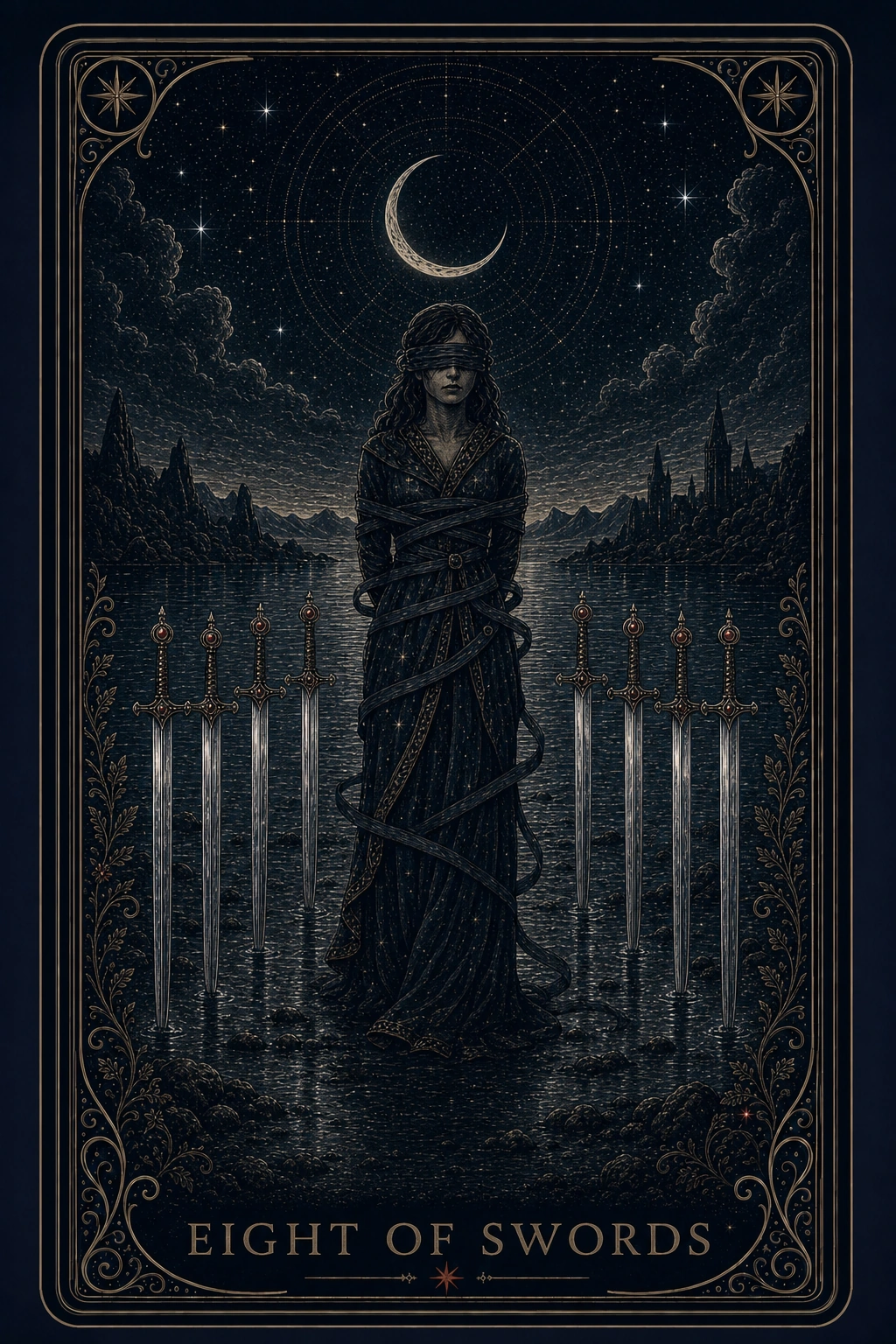
The Night Glass bindings trail. The deck drew the ribbons wrapping this figure with their ends loose in the water — spiraling down her body and simply... ending, anchored to nothing, drifting on the surface around her feet. No stake. No knot to a post. The restraint system's entire foundation is that she hasn't moved.
The eight swords stand in two rows, four and four — beside her. The deck's placement is the card's argument: nothing ahead, nothing behind. The blades form a corridor, not a cage, and the corridor is open at both ends. She stands in its exact center, in shallow water that reaches only her hem, on a path walkable in either direction.
Far behind her, the castle raises its lit towers — inhabited, warm-windowed, reachable. The world this card's conclusions ruled out is drawn present and operating, at the precise distance of one decision.
The Inverted Pattern
At full strength, the Eight stops being an episode and becomes a residence: the conclusions fence in more and more territory — the job, then the town, then the self — each "I can't" planted deeper by the comfort of the last one, until the fence is indistinguishable from the world. The inverted question: name one binding out loud — the exact sentence — and answer honestly: who told you that, when, and have you tested it since?
When It Finds You
The Eight of Swords tends to appear in the airless seasons — trapped in the role, the pattern, the story, with every exit already explained away. It appears right before the tug: one binding is ready to be tested, and it's the one you cited most recently. And it appears as a dare disguised as a card: take off the blindfold for one honest hour. Count what's actually in front of you.
The Lineage
The bound and blindfolded figure among planted swords has stood in this card since the early decks — and the painters, century after century, committed the same quiet subversion: they never drew the bindings tight. Loose wraps, trailing ends, swords that fence nothing. Six hundred years of the image whispering its own solution to anyone who studied it closely.
The Signal Door
What it names in you is different.
This is what Eight of Swords means in general. What it names in you is a different question.
The Signal reads one card for you — your name, where you actually are, and a pattern named with precision. It opens once per person.