Minor Arcana · Pentacles
Six of Pentacles
In One Line
The scales are in the picture for a reason. Giving without them is leaking. Giving with them is architecture.
What Six of Pentacles Names
The Six of Pentacles names circulation — coin returned to motion after the Four's grip and the Five's winter. It is the suit's card of giving and receiving drawn as one system: the same image holds the open palm and the outstretched hand, and the card insists they are two positions in a single economy, not two kinds of people. Everyone who holds this card has knelt on it somewhere, or will.
Its central instrument is the scales, and the deck means them. Generosity without measure isn't higher generosity — it's unaccounted flow, and unaccounted flow breeds what every unmeasured system breeds: depletion on one side, dependence on the other, and a quiet ledger of resentment kept by both. The scales make the giving sustainable and the receiving dignified. Measure is what turns charity into structure.
And it names the harder half of the exchange: receiving well. The kneeling hand held open, the thanks given without collapse — taking help without converting it into either shame or identity is a skill, and the card ranks it equal to the giving.
On This Card
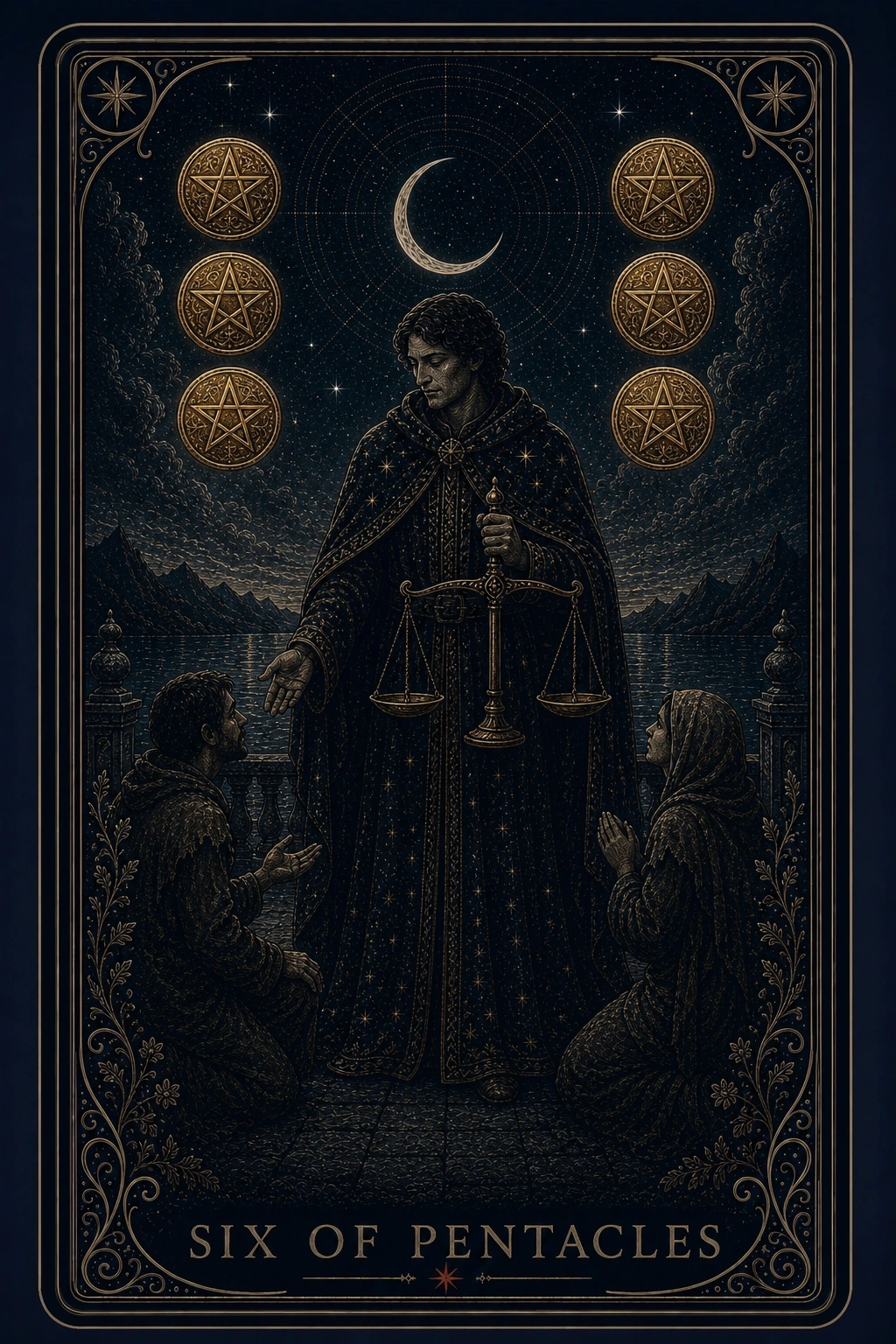
The Night Glass giver holds the scales up — center frame, at heart height, the card's true subject. His other palm opens downward toward the kneeling man whose hand rises to meet it, and the deck froze the exchange at the exact moment before transfer: the space between the two hands is the most charged gap on the card. What passes across it will be coin for an instant and relationship after that.
The two kneeling figures answer each other across the composition — one with the open asking hand, one with hands folded in thanks. The deck drew the receiving in both tenses: the ask and the after. Neither posture is shamed. Both are drawn in the same fine gold line as the giver's cloak.
Above, the six coins hold two columns of three — three over each kneeling figure, stacked like the standing balance the scales below are working toward. The card's geometry does its accounting: measure at the center, and the wealth distributed evenly across the top, the way it only ever gets distributed when someone holds the scales honestly.
The Inverted Pattern
Running blocked, the Six becomes flow with a hook: giving that purchases — status, gratitude, leverage, the upper position made permanent — or receiving that settles in as residence. The scales get palmed; the exchange keeps its shape and loses its measure. The inverted question: in your current giving, what comes back to you — be exact — and could you keep giving if it stopped?
When It Finds You
The Six of Pentacles tends to appear when you're the resourced one and the ask has arrived — give, and bring the scales. It appears when you're the asking one: kneel honestly, take it clean, plan your own future palm. And it appears in long imbalances — marriages, families, partnerships — as an audit of which hand each person has been stuck in, and for how long.
The Lineage
The merchant with scales and beggars has held this card since the first decks — painted by cities that invented both the bank and the public charity in the same century, and saw no contradiction. The Renaissance weighed everything: gold, grain, souls. Its most radical idea sits quietly in this image — that mercy itself deserves the dignity of measure.
The Signal Door
What it names in you is different.
This is what Six of Pentacles means in general. What it names in you is a different question.
The Signal reads one card for you — your name, where you actually are, and a pattern named with precision. It opens once per person.