Minor Arcana · Swords
King of Swords
In One Line
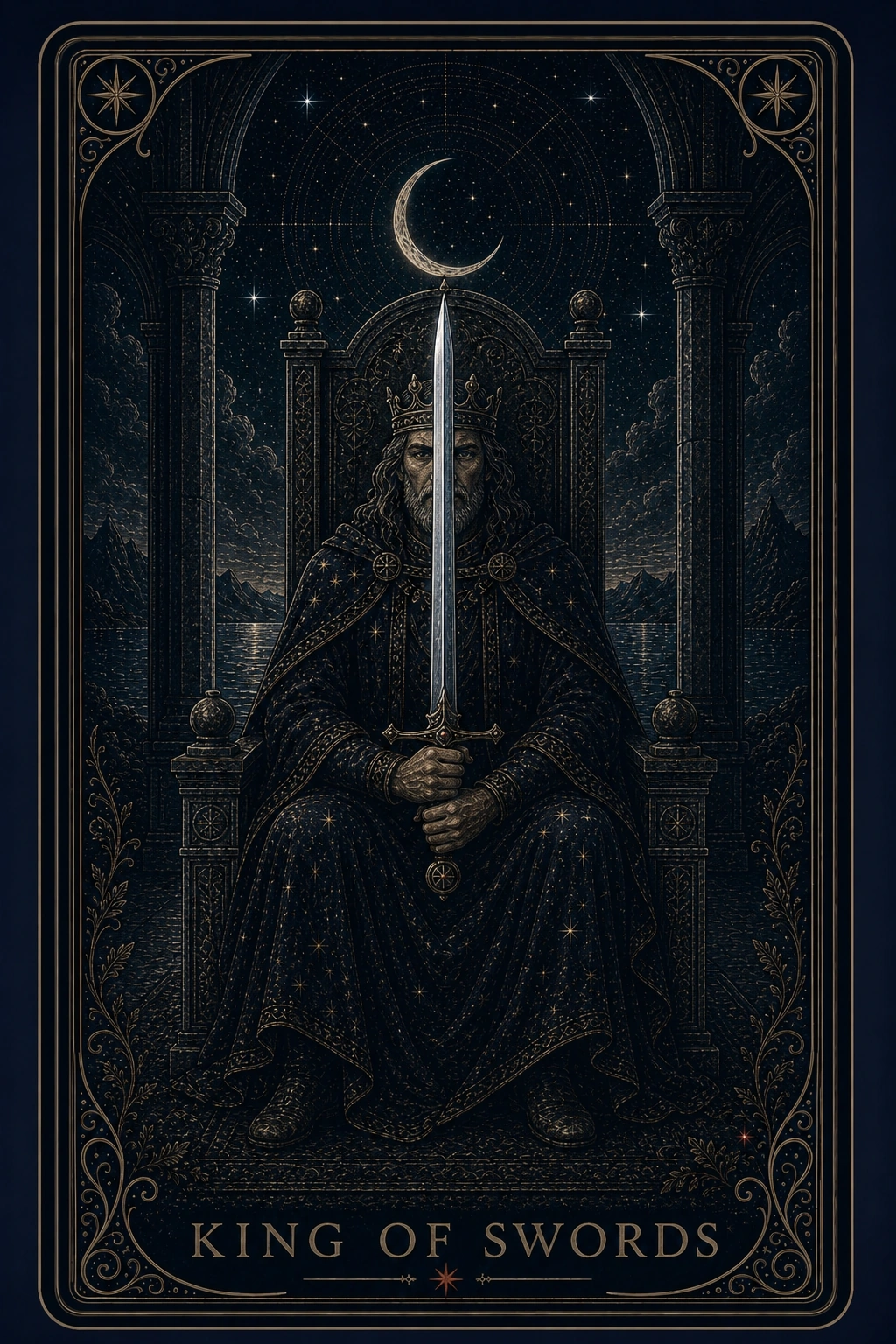
The blade splits his face down the middle — one eye on each side of the truth. That's the job: to see both halves and still keep the edge exactly vertical.
What King of Swords Names
The King of Swords names the mind at final authority — thought that has become structure. He is the suit's completion: the Page's watching, the Knight's charge, and the Queen's earned precision, resolved into the figure who no longer wields the sword so much as administers it. The judge, the arbiter, the one whose ruling ends the argument because everyone in the room knows it was reached on the merits.
The card's core is impartiality as a discipline. Every mind runs a thumb on its own scale — the favored outcome, the flattering read, the exception for itself. The King's whole office is the daily, unglamorous work of lifting that thumb: the standard applied to allies at the same angle as rivals, to himself first of all. Authority of this kind isn't granted. It accrues, one even-handed ruling at a time, and it can be spent to zero by a single crooked one.
And the deck keeps his edge warm-blooded: this is judgment in service of the realm, not of the judging. A King of Swords who has stopped caring what the rulings are for has already become his own inverted card.
On This Card
The Night Glass composition is the boldest in the court: the great sword rises dead-center, perfectly vertical, and bisects the King's own face — one eye on each side of the blade. The deck drew the office itself. To hold this seat is to have the standard run straight through you: both eyes open, one on each half of every question, the edge dividing even the judge. He is not behind the sword or beside it. He is measured by it, publicly, in his own portrait.
Both hands rest on the grip at his lap — the sword neither raised nor sheathed, held at exactly the readiness of a standing court. Above, the blade's point rises to the crescent moon, the deck's repeating border between mind and mystery: even the final authority's edge ends at that line, and the card draws him unbothered by the limit.
He faces fully forward — the only Swords figure drawn with no angle, no profile, no glance aside. Frontal, level, symmetrical. Nothing about this seat is oblique. You always know exactly where the King of Swords is looking: at the matter, straight on.
The Inverted Pattern
Running blocked, the King becomes verdict without service: the standard worshiped over the realm it was for — rulings issued for the pleasure of the ruling, people processed as cases, the one thumb never lifted: his own. The blade drifts off vertical by a degree a year, and no one at court is positioned to say so. The inverted question: who in your life is currently allowed to tell you your edge has drifted — and when did you last actually ask them?
When It Finds You
The King of Swords tends to appear when a matter needs a ruling — yours to make, evenly, with your own thumb lifted first. It appears around a mind of this caliber whose fairness is the thing to study. And it appears at the threshold where your thinking is becoming structure other people stand on — the policy, the precedent, the family's standard. Set the blade vertical. It will be inherited at whatever angle you leave it.
The Lineage
The King of the blades closed the suit's court from the first Italian decks — the sword-hand of the state, painted frontal century after century while every other court figure got an angle. The painters knew what they were saying: judgment must be met face-on to be trusted, and the seat only holds if the one in it can be looked at straight. Six hundred years, one posture.
The Signal Door
What it names in you is different.
This is what King of Swords means in general. What it names in you is a different question.
The Signal reads one card for you — your name, where you actually are, and a pattern named with precision. It opens once per person.